
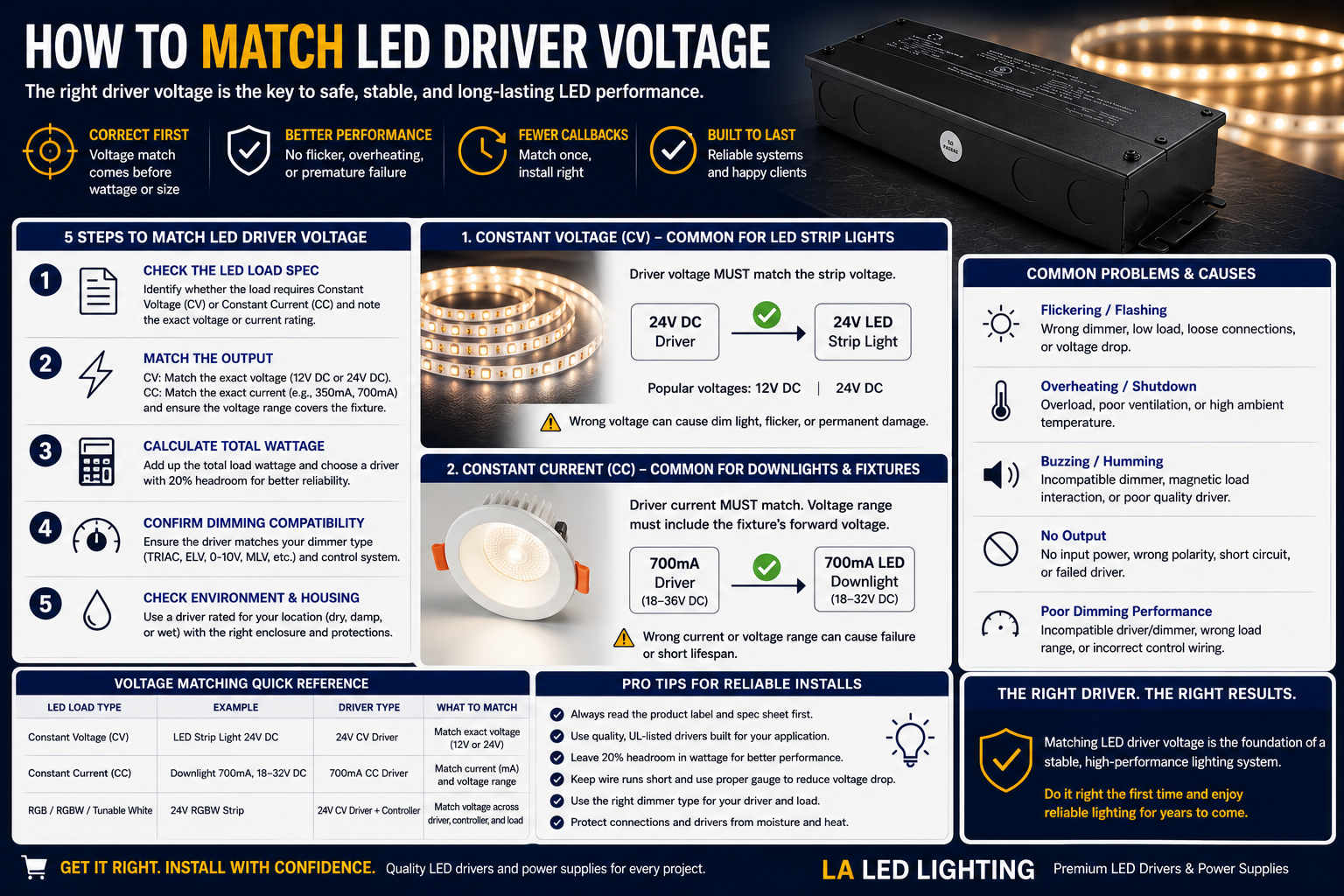
How to Match LED Driver Voltage
Many LED lighting problems start with a simple mistake: using the wrong driver voltage. If you're trying to figure out how to match LED driver voltage, the goal is straightforward—the driver and the LED load must be electrically compatible. When they are properly matched, you get reliable performance, smooth dimming, and longer system life. When they are not, you can experience flickering, overheating, poor brightness, shortened lifespan, or complete system failure.
Whether you're installing LED strip lights, recessed downlights, architectural fixtures, or landscape lighting, selecting the correct driver is one of the most important decisions in the entire system.
How to Match LED Driver Voltage Correctly
The first rule is simple: match the driver to the LED load, not the other way around.
Many buyers focus on wattage first, but voltage compatibility always comes before wattage sizing. Two drivers may have the same wattage rating and still be completely incompatible with the fixture.
LED drivers generally fall into two categories:
Constant Voltage Drivers
Constant voltage drivers deliver a fixed DC voltage, most commonly:
- 12V DC
- 24V DC
These drivers are commonly used for:
- LED strip lights
- COB LED strips
- RGB and RGBW lighting
- Under-cabinet lighting
- Cove lighting
- Architectural tape lighting
Constant Current Drivers
Constant current drivers provide a fixed current output such as:
- 350mA
- 500mA
- 700mA
- 1050mA
The driver automatically adjusts voltage within a specified range to match the fixture.
These drivers are often used for:
- LED downlights
- Puck lights
- Commercial luminaires
- Integrated LED fixtures
- Architectural lighting systems
Understanding which type your fixture requires is the first step in selecting the correct driver.
Start With the LED Fixture Specifications
Before choosing a driver, check the LED product specifications.
For LED strip lighting, the voltage is usually clearly listed:
- 12V DC
- 24V DC
Matching is straightforward.
A 24V strip requires a 24V driver.
A 12V strip requires a 12V driver.
For fixtures using constant current, the specifications may look something like:
- 700mA
- 30-42V DC
In this case, you need:
- A 700mA constant current driver
- A driver voltage range that includes 30-42V
If the fixture specifications are unclear, do not guess. Incorrect driver selection is one of the most common causes of LED system failure.
Matching Constant Voltage Drivers
Constant voltage systems are the most common type used for LED strip lighting.
Popular applications include:
- Under-cabinet lighting
- Kitchen lighting
- Cove lighting
- Display lighting
- RGB systems
- RGBW systems
- Tunable white systems
The rule is simple:
12V Strip = 12V Driver
24V Strip = 24V Driver
The voltage must match exactly.
Using a higher voltage driver will damage the LEDs.
Using a lower voltage driver will result in poor performance or prevent the system from operating altogether.
A typical constant-voltage product is the Indoor Dotless Dimmable COB LED Strip (10mm, 24V), which lists its voltage and watts per foot directly on the product page so the driver match is unambiguous. The full COB LED strip light range covers both 12V and 24V options for residential and commercial work.
Matching Constant Current Drivers
Constant current fixtures require a slightly different approach.
Instead of matching voltage directly, you match the required current first.
For example:
Fixture requirement:
- 700mA
- 24-36V DC
Compatible driver:
- 700mA output
- Voltage range covering 24-36V
The current must match exactly.
The voltage range must include the fixture's operating voltage.
If either specification is wrong, the fixture may fail to operate correctly or could be damaged.
Wattage Comes After Voltage
One of the biggest mistakes people make is choosing a driver based only on wattage.
Wattage is important, but it is not the starting point.
First:
- Match voltage or current requirements
Then:
- Calculate total wattage
For example:
A 24V LED strip consuming:
- 5 watts per foot
- 20 feet total
Equals:
100 watts total load
Rather than selecting a 100W driver, it's usually better to add capacity headroom.
A 120W or 150W 24V driver is often the better choice because it:
- Runs cooler
- Improves reliability
- Extends driver life
- Supports stable performance
For that exact 100W example, a 150W 5-in-1 Dimmable LED Driver leaves roughly 120W of usable capacity, which is the headroom described above.
Dimming Compatibility Matters Too
Matching voltage alone does not guarantee proper operation.
If the project includes dimming, the driver must support the correct dimming method.
Common options include:
- TRIAC
- ELV
- MLV
- 0-10V
Using the wrong dimming protocol can cause:
- Flickering
- Buzzing
- Dead travel on the dimmer
- Limited dimming range
- Dropouts at low light levels
A driver that accepts all four protocols, such as the 200W 5-in-1 Dimmable LED Driver, avoids this problem entirely. For commercial and architectural projects, the 0-10V dimmable LED driver range is built for smooth dimming across a wide load range.
What Happens When Driver Voltage Is Wrong?
Incorrect voltage can cause a wide range of problems, including:
- Flickering lights
- Poor brightness
- Color inconsistencies
- Driver overheating
- Reduced LED lifespan
- Dimming issues
- Complete fixture failure
Sometimes the lights may still turn on, creating the false impression that the driver is correct. However, long-term reliability often suffers when voltage requirements are not properly matched.
This is especially important for outdoor and wet-location installations where replacement can be difficult and costly.
A Simple Driver Matching Checklist
Follow this process every time:
Step 1
Identify whether the LED load requires:
- Constant Voltage
- Constant Current
Step 2
Match:
- Exact voltage for constant voltage systems
- Exact current for constant current systems
Step 3
Verify the voltage range covers the fixture requirements.
Step 4
Calculate total wattage and add capacity headroom.
Step 5
Confirm dimming compatibility.
Step 6
Verify environmental ratings for dry, damp, or wet locations.
Following these six steps eliminates most driver selection mistakes.
Common Driver Matching Mistakes
Assuming All LED Products Are 12V
Many modern LED systems now use 24V because it allows longer runs and reduces voltage drop.
Always verify before ordering. If a project could go either way, a selectable driver such as the 60W 5-in-1 Dimmable LED Driver (12V / 24V) can be set to match whichever strip is used.
Matching Wattage Only
Two drivers can have the same wattage rating but completely different output types.
Voltage or current specifications always come first.
Ignoring Dimming Requirements
A driver may power the LEDs correctly while still producing poor dimming performance if the control method is wrong.
Replacing Drivers Based on Appearance
Matching housing size, connector style, or wattage alone is not enough. Always match electrical specifications.
Using Indoor Drivers Outdoors
The correct voltage does not make a driver suitable for outdoor use. Environmental ratings must match the installation location. For damp and wet locations, use a sealed unit such as the 96W Dimmable LED Transformer (24V, IP65).
Final Thoughts
Learning how to match LED driver voltage is one of the most important skills in LED system design. The process is straightforward when you follow the proper order: identify the load, determine whether it requires constant voltage or constant current, match the electrical specifications, size wattage correctly, and confirm dimming compatibility.
For most LED strip lighting applications, matching a 12V or 24V constant voltage driver is simple. For constant current fixtures, matching the required current and voltage range is essential.
The best LED installations are built as complete systems where the strip, fixture, driver, controller, and dimmer all work together. Get the voltage right from the start, and you'll avoid costly troubleshooting while delivering lighting that performs reliably for years.