
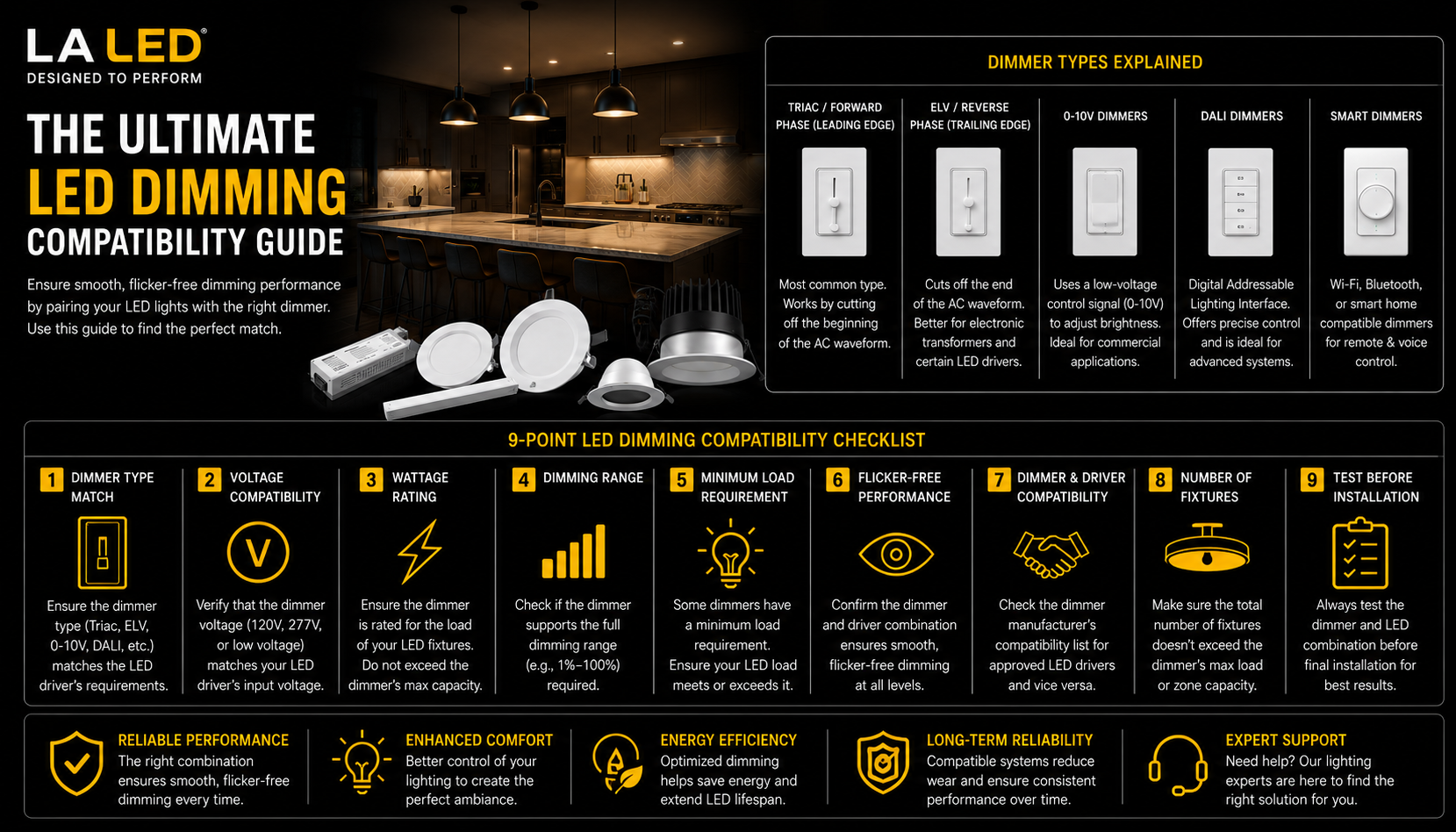
A dimmer that worked perfectly with incandescent lamps can turn an LED system into a callback waiting to happen. The point of an LED dimming compatibility guide is simple: get the dimmer, driver, and fixture working as one system before the wall plate goes on. If you are planning a residential remodel, office upgrade, landscape lighting install, or a custom tape light run, compatibility is what separates smooth fade performance from flicker, buzzing, dropouts, and dead travel on the dimmer.
LED dimming is not difficult, but it is less forgiving than legacy lighting. Incandescent lamps dimmed because the filament naturally responded to lower voltage. LEDs do not work that way. They need a driver or power supply to regulate current or voltage, and that electronic component has to interpret the dimming signal correctly. If the dimmer and the driver speak different languages, the result is usually unstable light output.
Why LED dimming compatibility matters
Most dimming problems are not caused by a defective light. They come from a mismatch between three pieces of the system: the control, the driver, and the load. A dimmer may be rated for LED use, but that alone does not guarantee performance with every fixture or strip light setup. The driver must also support that dimming method, and the connected load must fall within the operating range the dimmer expects.
This matters even more on premium residential and architectural jobs where smooth low-end dimming is part of the finished look. In high-end homes, restaurants, offices, and exterior feature lighting, visible stepping, shimmer, or sudden shutoff at 20 percent is not acceptable. A compatible system protects the finish quality of the project and reduces troubleshooting time after installation.
The core dimming types in this LED dimming compatibility guide
The most common source of confusion is mixing dimming protocols. The names sound familiar, but the electrical behavior is different.
TRIAC and forward phase dimming
TRIAC dimming, often called forward phase, is common in residential wall dimmers. It was originally designed for incandescent and magnetic loads, but many LED drivers are now built to work with it. This is often the easiest retrofit option when replacing old fixtures because the existing in-wall control may already be a TRIAC-style dimmer.
That said, TRIAC can be hit or miss with some LED loads. It depends on the driver design, minimum load requirements, and the dimmer model itself. On smaller LED loads, especially a single fixture or a short run of strip lighting, some TRIAC dimmers may not track smoothly at the low end.
ELV and reverse phase dimming
ELV dimming, or reverse phase dimming, is usually the better choice for many electronic LED drivers. It tends to offer quieter performance and smoother dimming, especially with premium fixtures and architectural tape lighting systems. If the driver specifically calls for ELV, using a standard TRIAC dimmer instead can produce erratic results even if the lights turn on.
ELV dimmers are often preferred when the goal is refined dimming behavior, but they are not automatically interchangeable with TRIAC. The driver still has to be rated for ELV input.
MLV dimming
MLV refers to magnetic low voltage dimming. This method is used with magnetic transformers, not electronic drivers. It is less common in newer LED systems but still appears in retrofit conditions and specialty applications. If your system uses an electronic LED driver and you pair it with an MLV dimmer, you are asking for trouble.
0-10V dimming
0-10V is standard in many commercial projects, offices, retail spaces, and larger residential applications with centralized controls. Instead of cutting the AC waveform like TRIAC or ELV, 0-10V uses a low-voltage control signal that tells the driver how bright to run the LEDs. It is stable, scalable, and often the preferred option when multiple fixtures need consistent performance.
The trade-off is wiring. A 0-10V system needs the correct driver plus dedicated low-voltage dimming conductors. It is not a swap-in solution for a standard line-voltage wall dimmer unless the system was designed for it.
How to match the dimmer, driver, and load
The practical rule is this: start with the driver specification, not the dimmer packaging. If the driver says TRIAC dimmable, use a compatible TRIAC dimmer from the approved range when possible. If it says ELV only, use ELV. If it says 0-10V, treat it as a 0-10V system from the start.
Load size also matters. LEDs draw much less wattage than incandescent lamps, and some older dimmers do not perform well at low loads. A dimmer that once controlled 600 watts of incandescent lighting may technically accept LED lamps, but if the connected LED load is only 20 or 30 watts, the dimming curve may be poor. This is why minimum load and LED-rated compatibility are worth checking before installation.
For strip lighting, the relationship becomes even more important because the strip itself is only one part of the system. You also need the correct driver or transformer, and in tunable white, RGB, or RGBW applications, the controller has to be compatible too. A high-quality COB strip paired with the wrong dimmable driver will not deliver premium results no matter how good the LEDs are.
LED dimming compatibility guide for common applications
Recessed downlights and retrofit fixtures
For residential downlights, the most common path is a fixture with an integrated dimmable driver paired with an LED-rated wall dimmer. This can work very well, but fixture-level compatibility lists still matter. Two fixtures labeled dimmable may behave differently on the same dimmer.
If you are replacing older recessed cans in a home, make sure the dimmer is designed for LED loads and not just legacy incandescent or halogen use. Pay attention to low-end performance if the homeowner wants soft evening light rather than basic on-off control.
LED strip and tape light systems
Strip lighting gives you more flexibility, but it also adds more decision points. You need the correct voltage, enough wattage capacity, the proper dimming driver, and a controller if the system is color-changing or tunable.
For single-color strip lights, the dimming method is usually determined by the driver. A line-voltage dimmable driver can support TRIAC or ELV wall control, while a non-dimming driver may need a separate low-voltage PWM controller. Those are not interchangeable approaches. If the design calls for wall dimming from a conventional switch box, choose the driver around that requirement from the beginning.
For tunable white, RGB, RGBW, and pixel-style systems, dimming is often handled through dedicated controllers and remotes rather than standard wall dimmers. In those cases, trying to force compatibility with a basic line-voltage dimmer misses the point of the control architecture.
Commercial and office lighting
In commercial settings, 0-10V is often the cleanest answer because it supports consistent dimming across multiple fixtures and zones. It is especially useful where lighting controls are integrated with occupancy sensors, daylight harvesting, or scene settings.
The main caution is planning. A 0-10V driver without the right control wiring becomes a missed opportunity, while a line-voltage dimming driver may not fit the control scheme the project actually needs.
Common dimming problems and what they usually mean
Flicker usually points to incompatibility, an unstable dimming signal, or a driver operating outside its preferred range. Buzzing often suggests a phase-cut mismatch or a dimmer struggling with the connected LED load. Lights that drop out early during dimming often indicate poor low-end performance or a minimum load issue. If the fixture never reaches full brightness, the dimmer and driver may not be calibrated to each other correctly.
There is also the issue of mixed loads. Combining different fixture types or driver types on one dimmer can create uneven results, even if each product is dimmable on its own. On cleaner projects, keeping dimming zones electrically consistent saves time and protects performance.
What to check before you buy
Read the driver specs first. Confirm the dimming method, input voltage, output type, and whether the product is intended for dry, damp, or wet locations. Then confirm the dimmer is LED-rated and suitable for that exact dimming method. After that, verify the total connected load and leave reasonable headroom on the driver.
For trade professionals, this step prevents expensive rework. For homeowners and remodelers, it avoids the common mistake of buying a dimmable light and assuming any dimmer will do the job. It will not.
If you are sourcing premium components for residential, commercial, or landscape projects, it pays to buy from a supplier that understands the relationship between strip lights, drivers, transformers, and controls rather than treating them as separate product categories. That is where practical compatibility support matters. LA LED Lighting focuses heavily on dimmable LED systems because performance on paper only matters if the install works on-site.
Good dimming is not about getting the lights to respond. It is about getting them to respond smoothly, quietly, and predictably every day. When the dimmer, driver, and fixture are matched correctly, the system disappears into the space the way good lighting should.