
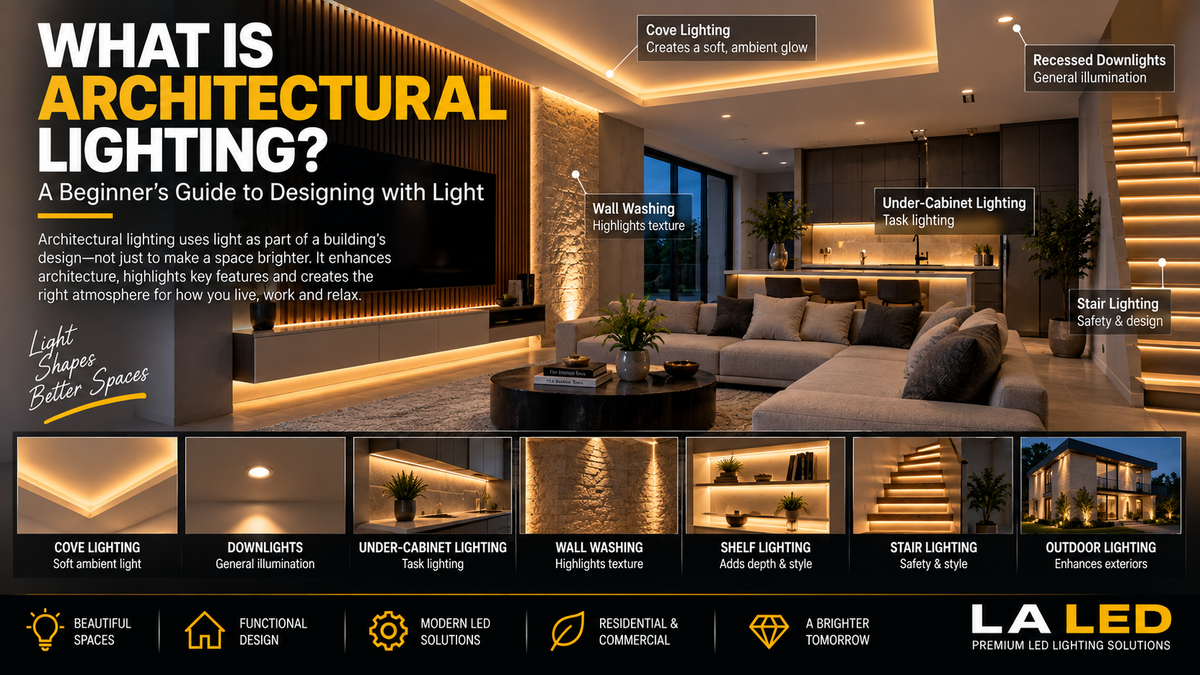
What Is Architectural Lighting? A Beginner’s Guide
Walk into a beautifully designed hotel, restaurant, luxury home, or modern retail store and you may notice something interesting.
You notice the space.
You notice the:
- Textures
- Walls
- Ceilings
- Furniture
- Artwork
- Materials
- Architectural details
But you may barely notice the actual light fixtures.
That is often the goal of architectural lighting.
Instead of simply placing a lamp in a room to provide brightness, architectural lighting integrates light into the design of the space itself.
The light helps define:
Shape + Texture + Depth + Mood + Function
In many modern projects, LED technology—especially COB LED strips, aluminum profiles, recessed downlights, and dimmable controls—makes this type of lighting much easier to achieve.
So what exactly is architectural lighting, and how can you use it?
Let's start with the basics.
What Does Architectural Lighting Mean?
Architectural lighting is the intentional use of light to support and enhance the architecture of a space.
Traditional lighting often starts with the question:
“Where should we put the lights?”
Architectural lighting starts with a different question:
“What parts of the space should light reveal?”
For example, lighting might be used to emphasize:
- A textured stone wall
- A floating ceiling
- Kitchen cabinetry
- A staircase
- Shelving
- Artwork
- An architectural column
- A curved wall
- A ceiling recess
- Exterior landscaping
The fixture itself may be hidden or visually minimal.
The effect of the light becomes the main feature.
Architectural Lighting vs. Regular Lighting
The difference is not always the type of fixture.
It is often how the light is used.
Regular Lighting
The primary goal may simply be:
Provide enough light to see.
For example:
A ceiling fixture in the center of a bedroom.
Architectural Lighting
The goal becomes:
Provide useful illumination while enhancing the design of the room.
For example:
Recessed Downlights
Hidden COB Cove Lighting
Wall-Washing Light
Bedside Accent Lighting
The room is no longer illuminated from one source.
It is built from multiple layers of light.
The Three Main Layers of Lighting
A useful way to understand architectural lighting is to divide it into three basic layers.
1. Ambient Lighting
Ambient lighting provides the overall illumination of a space.
Examples include:
- Recessed downlights
- Cove lighting
- Indirect ceiling lighting
- Large architectural fixtures
Its job is to establish the general brightness level.
Think of ambient lighting as the foundation.
2. Task Lighting
Task lighting provides additional illumination where specific activities happen.
Examples include:
- Under-cabinet lighting
- Vanity lighting
- Desk lighting
- Kitchen-counter lighting
- Closet lighting
Task lighting should help people perform activities comfortably.
For example:
A kitchen may already have downlights.
But installing COB LED strips beneath the upper cabinets can illuminate the countertop more effectively. Our Indoor Dotless COB LED Strip (8mm) is sized for standard cabinet undersides.
3. Accent Lighting
Accent lighting creates visual interest.
Instead of lighting everything equally, it directs attention toward specific features.
Accent lighting may highlight:
- Artwork
- Stone
- Shelving
- Plants
- Architectural walls
- Columns
- Display objects
This creates contrast and depth.
A well-designed room often combines:
Ambient + Task + Accent
rather than relying on one lighting source.
Why Is Architectural Lighting Important?
Without thoughtful lighting, even an expensive interior can appear flat.
Imagine a room where every surface receives approximately the same amount of light.
There is little visual hierarchy.
Now imagine the same room with:
Soft ceiling glow
Bright countertop lighting
Subtle wall washing
Highlighted artwork
Warm shelf lighting
Suddenly, the room has depth.
Architectural lighting helps create that visual structure.
1. Cove Lighting
Cove lighting is one of the most recognizable forms of architectural lighting.
The light source is hidden inside an architectural recess.
Instead of seeing the LED strip directly, you see reflected light.
A typical design works like:
Hidden COB LED Strip
↓
Light Directed Toward Ceiling
↓
Ceiling Reflects Light
↓
Soft Ambient Glow
Cove lighting can make a room feel:
- Larger
- Softer
- More luxurious
- More relaxing
- More architecturally interesting
For most residential coves, the 10mm Indoor Dotless COB Strip provides a continuous, dot-free line of light that reflects evenly off the ceiling.
Why COB LED Strips Work Well for Cove Lighting
COB LED strips are particularly useful for architectural lighting because they produce a smooth, continuous-looking line of light.
Traditional LED strips with widely spaced individual LEDs can sometimes create visible dots.
COB technology reduces this effect.
This makes COB strips excellent for:
- Cove lighting
- Shelving
- Cabinet lighting
- Wall details
- Ceiling details
- Linear architectural lighting
Even when the strip is partially visible through a diffuser, the light can appear much smoother.
Browse our full single-colour COB strip range, from 6.5mm ultra-slim up to 12mm double-row, in 2700K through 5000K.
2. Recessed Linear Lighting
Another popular architectural technique is integrating linear light directly into:
- Ceilings
- Walls
- Cabinetry
- Millwork
Instead of attaching an LED strip visibly to the surface, the strip can be installed inside an aluminum profile.
Some profiles can be recessed so the finished result looks like a built-in line of light.
The result can be:
Ceiling → Light Line → Ceiling
rather than:
Ceiling → Visible LED Strip
This creates a much more architectural appearance.
3. Plaster-In LED Channels
Plaster-in aluminum channels take integration even further.
These profiles can be incorporated into drywall or other compatible architectural construction so that much of the channel becomes visually hidden.
After finishing, you mainly see:
A clean illuminated line
rather than a bulky fixture.
Plaster-in profiles can be used for:
- Ceilings
- Walls
- Hallways
- Modern living rooms
- Commercial interiors
- Feature walls
They are especially useful in minimalist designs.
4. Surface-Mount Linear Lighting
Not every architectural installation needs to be recessed.
Surface-mounted aluminum profiles can still create a clean professional appearance.
They are useful where cutting into the ceiling or wall is:
- Difficult
- Expensive
- Impossible
- Unnecessary
A slim aluminum channel with COB strip and diffuser can look much more finished than an exposed LED strip.
5. Corner Lighting
Corners offer another opportunity for integrated lighting.
A corner aluminum channel can position the LED strip at an angle.
This can be useful where:
Wall meets ceiling
Cabinet meets wall
Shelf meets vertical surface
Angling the light can help create a smoother wash across the adjacent surface.
6. Wall Washing
Wall washing illuminates a large portion of a vertical surface relatively evenly.
Imagine a textured wall.
Without dedicated lighting:
Texture → Difficult to notice
With appropriate wall washing:
Texture → Visible and emphasized
Wall washing can work beautifully on:
- Stone walls
- Brick
- Wood panels
- Large artwork
- Architectural finishes
- Commercial feature walls
The goal is generally to illuminate the surface smoothly rather than create isolated bright spots.
Washing a tall wall evenly takes more output than a typical cove, which is where the 12mm Double-Row High-Brightness COB Strip is the better fit.
7. Wall Grazing
Wall grazing is related to wall washing, but the effect is different.
The light source is positioned relatively close to the wall so the light travels across the surface at a sharper angle.
This can emphasize texture.
Imagine a stone wall.
Light from the front may make it look relatively flat.
Light traveling across the surface can create:
Highlight → Shadow → Highlight → Shadow
This reveals the texture dramatically.
Wall grazing can be particularly effective for:
- Natural stone
- Brick
- Rough concrete
- Textured panels
Wall Washing vs. Wall Grazing
| Technique | Main Goal |
|---|---|
| Wall Washing | Smooth, relatively even wall illumination |
| Wall Grazing | Emphasize texture and shadows |
| Accent Lighting | Draw attention to a specific feature |
| Cove Lighting | Create indirect ambient illumination |
Choosing between them depends on what you want people to notice.
8. Recessed Downlights
Downlights are another important architectural-lighting tool.
A well-designed downlight layout can provide general illumination without dominating the ceiling.
Modern interiors often use smaller, carefully positioned downlights rather than simply filling the ceiling with large fixtures.
Downlights can provide:
- Ambient lighting
- Task lighting
- Accent lighting
depending on their:
- Position
- Beam angle
- Output
- Tilt
- Optics
Our recessed downlight range covers 3-inch, 4-inch and 6-inch apertures, all CRI 90 with selectable colour temperature.
Fixed vs. Adjustable Downlights
Fixed Downlights
Direct light primarily downward.
Useful for:
- General illumination
- Hallways
- Kitchens
- Bedrooms
The 4-Inch 5CCT Flat Panel Downlight is a typical fixed, canless option.
Adjustable Downlights
Allow the beam to be aimed.
Useful for:
- Artwork
- Walls
- Architectural features
- Display areas
An adjustable downlight can transform from simple ceiling illumination into an architectural accent-lighting tool. The 4-Inch Multi-Direction Gimbal Downlight tilts up to 90° for exactly this.
9. Under-Cabinet Lighting
Under-cabinet lighting is both practical and architectural.
In a kitchen, ceiling downlights may leave shadows on countertops because your body can block some of the overhead light.
A hidden COB strip underneath the cabinet can illuminate the work surface directly.
This provides:
Task Lighting
while also creating:
Visual Depth
A clean installation can make cabinetry appear lighter and more refined.
10. Toe-Kick Lighting
Toe-kick lighting places a hidden light source near the bottom of:
- Kitchen cabinets
- Bathroom vanities
- Built-in furniture
The light reflects across the floor.
This can create the illusion that cabinetry is floating.
It works particularly well in contemporary interiors.
At night, toe-kick lighting can also provide low-level navigation lighting without turning on brighter ceiling lights. For an especially warm night-time glow, the 1800K Golden Yellow COB Strip is well suited to toe-kicks.
11. Shelf Lighting
Shelves can become architectural features when properly illuminated.
COB LED strips can be installed:
- Under shelves
- Behind shelves
- Inside display niches
- Within aluminum profiles
The goal is usually to hide the source while illuminating the objects or surfaces.
This works well in:
- Living rooms
- Bars
- Kitchens
- Retail stores
- Offices
- Display cabinets
For thin shelf edges and tight niches, the 6.5mm Ultra Slim COB Strip is the narrowest profile we carry.
12. Stair Lighting
Stairs are an excellent location for architectural lighting.
Possible approaches include:
- Under-step lighting
- Side-wall lighting
- Handrail lighting
- Recessed linear lighting
- Low-level guidance lighting
Good stair lighting can provide both:
Design + Function
The light should help define the steps without creating uncomfortable glare.
Because each step needs its own short length, the Cuttable Free-Cut COB Strip (8mm) is useful here—its short cut intervals fit tread widths without leaving dark ends.
13. Ceiling Perimeter Lighting
Instead of placing LED strips randomly around the ceiling, architectural perimeter lighting integrates the light into the ceiling design.
This may involve:
- Cove details
- Recessed profiles
- Floating ceilings
- Perimeter channels
When designed properly, the light source disappears and the architecture appears to produce the light.
14. Backlighting
Backlighting places the light source behind an object or architectural element.
Examples include:
- Mirrors
- Headboards
- TV panels
- Stone slabs
- Signs
- Decorative panels
The result is usually a halo or floating effect.
For example:
Wall → Hidden COB → Mirror
creates a glow around the mirror.
This can make the mirror appear visually separated from the wall.
15. Architectural Lighting Around a TV Wall
Modern TV walls are ideal for layered lighting.
You might combine:
Hidden COB behind TV panel
Shelf lighting
Recessed downlights
Low-level cabinet lighting
Instead of one bright ceiling fixture, several subtle sources create depth.
This can also make evening viewing more comfortable when properly designed.
16. Architectural Lighting in a Kitchen
A well-designed kitchen may contain several lighting layers.
Ceiling
Recessed downlights provide general illumination.
Countertops
COB strips under cabinets provide task lighting.
Island
Pendant lights provide functional and decorative illumination.
Cabinets
Internal or shelf lighting creates visual interest.
Toe Kick
Low-level lighting adds depth.
Instead of one light source doing everything, each layer has a specific purpose.
17. Architectural Lighting in a Bedroom
Bedrooms benefit from softer lighting.
A possible design could include:
Small recessed downlights
Hidden headboard COB lighting
Cove lighting
Bedside lighting
This allows you to use bright illumination when needed and softer lighting at night.
For bedrooms, warmer color temperatures such as 2700K or 3000K are often popular. The 4-Inch Downlight with Night Light adds a built-in soft night mode that suits this layered approach.
18. Architectural Lighting in a Living Room
Living rooms need flexibility because they serve many purposes.
You may use the same room for:
- Conversation
- Reading
- Watching TV
- Entertaining
- Relaxing
A layered lighting system might combine:
Downlights → General Light
COB Cove → Ambient Light
Adjustable Downlights → Artwork
Lamps → Reading
Shelf Lighting → Accent
With dimming, the same room can have completely different moods.
19. Architectural Lighting Outdoors
Architectural lighting isn't limited to interiors.
Exterior lighting can emphasize:
- Building facades
- Columns
- Steps
- Pathways
- Landscaping
- Trees
- Outdoor kitchens
- Decks
- Pergolas
The goal should usually be to reveal the architecture and landscape rather than simply flood everything with maximum brightness.
Good outdoor lighting uses contrast and restraint.
Outdoors, both the strip and the driver need an appropriate rating—our Outdoor Dotless COB Strip (8mm) pairs with the IP65-rated transformers.
20. Why Hidden Light Often Looks More Luxurious
One reason architectural lighting feels sophisticated is that the source is often concealed.
You don't necessarily see:
LED Strip
You see:
Beautifully Illuminated Surface
This changes the visual focus from the product to the architecture.
For example:
Instead of:
Visible LED Strip → Bright Line
you get:
Hidden COB → Soft Ceiling Glow
The second approach generally feels more integrated.
Aluminum Channels Are Part of the Design
An aluminum LED channel isn't only an accessory.
In architectural lighting, it can become part of the lighting system.
Depending on the profile, a channel can help provide:
- Straight installation
- Physical protection
- Heat transfer
- Diffusion
- Recessed mounting
- Surface mounting
- Corner mounting
- Plaster-in integration
Choosing the right profile can significantly change the finished appearance.
Why LED Strip Width Matters
Before choosing an aluminum channel, check the width of the LED strip.
Common strip widths include:
6mm
8mm
10mm
12mm
A strip must physically fit inside the channel.
Also consider whether the strip has a protective coating, because an IP65 version may be thicker than an IP20 version.
Our COB strips span these widths—the 6.5mm, 8mm, 10mm and 12mm—so confirm which you have before choosing a profile.
Color Temperature Changes Architecture
The same room can look dramatically different depending on color temperature.
2700K
Warm, comfortable, residential.
Great for:
- Bedrooms
- Living rooms
- Hospitality
3000K
Warm but slightly cleaner.
Excellent for:
- Modern homes
- Kitchens
- Living rooms
- Architectural lighting
4000K
Neutral and crisp.
Often useful in:
- Offices
- Workspaces
- Commercial interiors
Color temperature should support the materials and atmosphere of the space.
What Is CCT Tunable Lighting?
CCT-adjustable lighting allows you to change the white color temperature.
For example:
Warm White ↔ Neutral White ↔ Cool White
A tunable-white COB system can provide greater flexibility.
You might use:
Warmer light at night
and
Cooler light during daytime or task-oriented activities.
This can be particularly useful in multi-purpose spaces.
Our CCT COB LED Strip (2700K–6500K) pairs with a CCT driver with built-in dimmer to handle both brightness and colour temperature.
What About RGB and RGBW?
Architectural lighting doesn't have to be white.
RGB and RGBW systems can add color to:
- Entertainment spaces
- Restaurants
- Bars
- Gaming rooms
- Retail displays
- Feature walls
However, colored lighting is usually most effective when used intentionally.
A small amount of color can create impact.
Too much can overwhelm the architecture.
For architectural colour work, RGBW COB is usually the better choice over plain RGB, since the dedicated white channel lets the same strip fall back to clean white light when colour isn't wanted.
CRI Matters in Architectural Lighting
CRI—Color Rendering Index—describes how naturally colors appear under a light source.
High-quality light can improve the appearance of:
- Wood
- Stone
- Paint
- Furniture
- Food
- Artwork
- Skin tones
For spaces where color quality matters, 90+ CRI is often a useful target.
Architectural lighting isn't just about how bright the room is.
It's also about how the room looks under the light.
Beam Angle Matters
Downlights and directional fixtures can have different beam angles.
Narrow Beam
Creates concentrated illumination.
Useful for:
- Artwork
- Architectural features
- Accent lighting
Wide Beam
Spreads light across a larger area.
Useful for:
- General illumination
- Lower ceilings
- Broad surfaces
Beam angle affects how the light interacts with architecture.
Two fixtures with the same lumen output can produce very different visual effects.
Even within our own range the spread varies considerably—the 3-Inch Black Trim Downlight has a 120° beam, while the 4-Inch Retrofit is tighter at roughly 95°.
Dimming Is Essential
Architectural lighting becomes much more useful when it can be dimmed.
Imagine a living room at:
100% → Cleaning
60% → Guests
30% → Relaxing
10% → Watching a movie
The architecture hasn't changed.
The lighting has.
For LED systems, make sure the:
Dimmer + Driver + LED
are compatible. Our 5-in-1 Dimmable LED Drivers accept TRIAC, ELV, MLV, 0–10V and PWM, which makes that match far easier.
Lighting Zones Make a Big Difference
Instead of controlling every light from one switch, divide the room into zones.
For example:
Zone 1
Downlights
Zone 2
Cove lighting
Zone 3
Wall lighting
Zone 4
Shelf lighting
Zone 5
Decorative fixtures
This allows you to create different scenes.
Dinner
Movie
Entertaining
Cleaning
Night
can all use different combinations.
For LED strip zones, our LED controllers and remotes give each layer its own control.
Common Architectural Lighting Mistakes
Too Many Downlights
A ceiling filled with downlights can feel visually busy.
More fixtures don't automatically mean better lighting.
Visible LED Strips
If the goal is architectural lighting, hide the source whenever appropriate.
Wrong Color Temperature
Lighting that conflicts with interior materials can change the atmosphere dramatically.
No Dimming
Fixed high brightness reduces flexibility.
Ignoring Glare
A bright fixture in the wrong position can make an otherwise beautiful design uncomfortable.
Lighting Everything Equally
Without contrast, a room can look flat.
Choosing Products Before Designing the Effect
Start with:
What should the light accomplish?
Then select the products.
A Simple Architectural Lighting Formula for Beginners
If you're planning your first project, think in this order:
Step 1 — Ambient
How will the room receive general illumination?
Step 2 — Task
Where do people need extra light?
Step 3 — Accent
What architectural features should stand out?
Step 4 — Indirect Light
Where can hidden COB lighting add softness and depth?
Step 5 — Controls
Which lighting layers should be separately dimmed or controlled?
This simple approach can dramatically improve a lighting plan.
Example: Basic Living Room
Instead of installing twelve downlights and stopping there, you might use:
6–8 carefully positioned downlights
COB cove lighting
2 adjustable accent lights
Floor/table lamps
The exact number depends on room size, fixture output, ceiling height, and layout.
The key idea is:
Don't ask one fixture type to do every job.
Example: Modern Kitchen
A modern kitchen might use:
Downlights
for general lighting
COB under-cabinet strips
for tasks
Pendant lights
for the island
Toe-kick lighting
for low-level accent
Shelf lighting
for display areas.
Each source has a purpose.
Together, they create the architectural effect.
Example: Luxury Bedroom
A bedroom could combine:
Minimal downlights
Hidden 2700K COB headboard lighting
Warm cove lighting
Bedside lamps
With dimming, the room can transition from bright and functional to soft and relaxing.
Does Architectural Lighting Have to Be Expensive?
Not necessarily.
The effect often depends more on:
- Placement
- Concealment
- Layering
- Color temperature
- Dimming
- Proper product selection
than simply buying expensive fixtures.
A thoughtfully positioned COB strip in an aluminum channel can sometimes transform a space more dramatically than an expensive decorative fixture placed without a lighting plan.
Architectural Lighting vs. Decorative Lighting
They can work together, but they're not the same.
Architectural Lighting
Usually supports or integrates with the architecture.
Examples:
- Cove lighting
- Recessed linear lighting
- Downlights
- Wall washing
Decorative Lighting
The fixture itself is often part of the visual design.
Examples:
- Chandeliers
- Pendant lights
- Decorative sconces
- Table lamps
Great interiors often combine both.
The architectural lighting shapes the space.
The decorative lighting adds personality.
Final Thoughts
So, what is architectural lighting?
It's the use of light as part of the architecture itself.
Instead of simply asking:
“How do I make this room brighter?”
architectural lighting asks:
“How should this room look and feel?”
Then it uses:
Ambient Lighting + Task Lighting + Accent Lighting + Indirect Lighting
to create that experience.
Modern LED technology gives homeowners and designers more options than ever.
With:
COB LED strips
Aluminum channels
Recessed downlights
Dimmable drivers
Controllers
and thoughtful placement, light can become part of the building rather than simply something added afterward.
The best architectural lighting often has one defining characteristic:
You notice what the light does before you notice where the light comes from.
FAQ
What is architectural lighting in simple terms?
Architectural lighting uses light to enhance the structure, materials, function, and atmosphere of a space rather than simply providing general brightness.
What are the three main types of lighting?
A common approach divides lighting into ambient, task, and accent lighting. Good architectural designs often combine all three.
Are LED strips considered architectural lighting?
They can be. LED strips are commonly used for cove lighting, recessed linear lighting, shelving, cabinetry, backlighting, and other integrated architectural effects.
Why are COB LED strips good for architectural lighting?
COB strips produce a smooth, continuous-looking line of light, making them especially useful for hidden and linear architectural applications. See our COB LED strip range.
Do LED strips need aluminum channels?
Not every application requires one, but channels can improve mounting, heat transfer, protection, alignment, diffusion, and the overall finished appearance.
What is the difference between wall washing and wall grazing?
Wall washing aims to illuminate a larger wall surface relatively evenly, while wall grazing uses light at a sharper angle to emphasize texture and shadows.
What color temperature is best for architectural lighting?
It depends on the space. 2700K and 3000K are popular for residential interiors, while 4000K may suit some commercial and task-oriented spaces.
Is architectural lighting only for luxury homes?
No. The same principles can be applied to apartments, renovations, retail spaces, offices, restaurants, and ordinary homes.
Should architectural lighting be dimmable?
Dimming is highly valuable because it allows different lighting layers to create different moods and support different activities.
What should I plan first: fixtures or lighting effects?
Start with the desired effect and function. Decide what needs general, task, accent, or indirect illumination, then select fixtures and components that create those effects.