
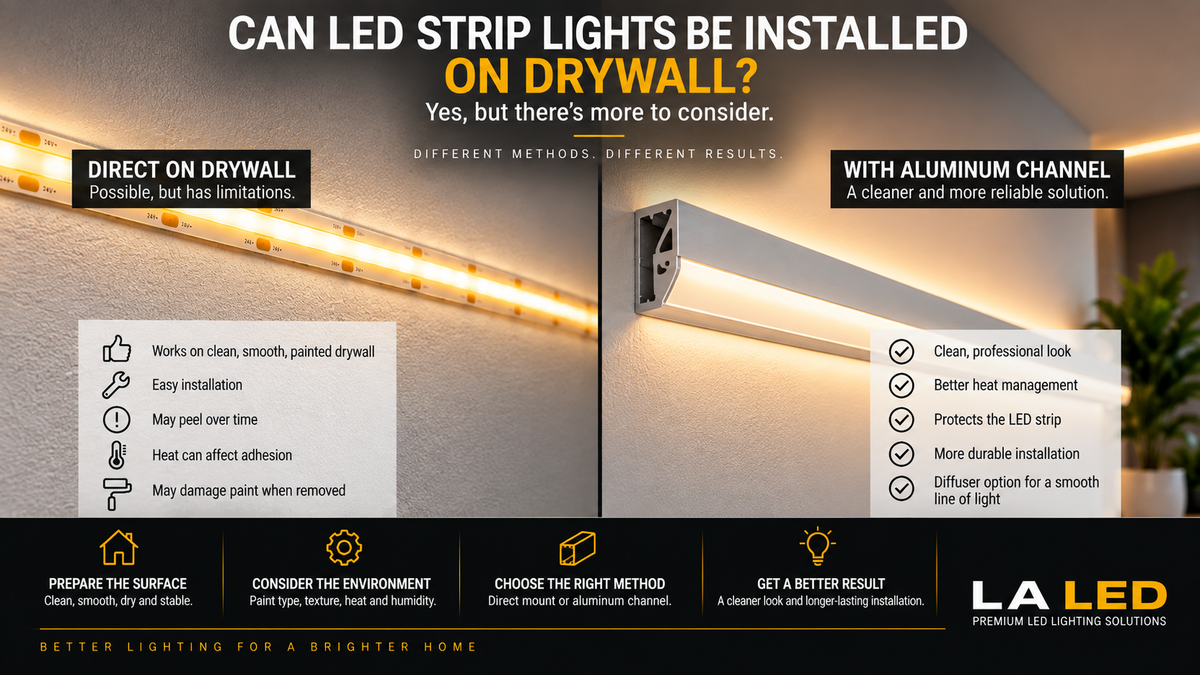
Can LED Strip Lights Be Installed on Drywall?
LED strip lights are one of the easiest ways to add modern lighting to a home.
They can be installed around:
- Bedrooms
- Living rooms
- TV walls
- Ceilings
- Shelves
- Closets
- Hallways
- Home offices
But many of these areas have one thing in common:
Drywall.
So a common question is:
Can you install LED strip lights directly on drywall?
The short answer is:
Yes—but direct installation isn't always the best option.
The condition of the wall, type of paint, adhesive, LED strip power, heat, and installation method can all affect the final result.
For many permanent installations, using an aluminum LED channel can provide a cleaner and more durable solution.
Let's look at the options.
Will LED Strip Lights Stick to Drywall?
Many LED strips include adhesive backing.
You remove the protective liner and press the strip onto the installation surface.
On smooth, clean, properly painted drywall, the adhesive may initially hold well.
However, several factors can cause the strip to eventually separate from the wall:
- Dust
- Grease
- Textured paint
- Old paint
- Fresh paint that hasn't fully cured
- Humidity
- Heat
- Poor-quality adhesive
- Uneven surfaces
- Repeated removal and reinstallation
So the question isn't only:
“Will it stick?”
The better question is:
“Will it stay attached reliably?”
1. Check the Drywall Surface First
Before installing anything, inspect the wall.
LED strip adhesive works best on a surface that is:
Clean + Smooth + Dry + Stable
Problems can occur if the wall is:
- Dusty
- Dirty
- Damp
- Heavily textured
- Flaking
- Cracked
- Poorly painted
If the paint itself isn't securely bonded to the drywall, even strong adhesive may pull the paint away rather than create a reliable installation.
2. Clean the Surface Before Installation
One of the most common installation mistakes is applying LED strip directly to a dusty wall.
Even a thin layer of dust can significantly reduce adhesion.
Before installation, remove:
- Dust
- Dirt
- Grease
- Residue
Use a cleaning method appropriate for the wall finish and allow the surface to dry completely.
Avoid leaving behind oily or soapy residue.
The strip needs a clean surface for the adhesive to bond properly.
3. Be Careful with Freshly Painted Walls
Installing LED strip immediately after painting is usually a bad idea.
Paint may feel dry to the touch before it is fully cured.
Applying strong adhesive too soon can:
- Damage the finish
- Prevent proper adhesion
- Pull paint away later
Always follow the paint manufacturer's curing recommendations before attaching adhesive products.
4. Textured Drywall Can Be Difficult
Smooth painted drywall is much easier for adhesive-backed strips.
Textured walls create another problem.
Instead of contacting the entire surface, the adhesive touches only the raised areas.
That means less bonding area.
For example:
Smooth Wall
Adhesive → ███████████
versus
Textured Wall
Adhesive → █ ░ █ ░ █
Less contact generally means weaker adhesion.
For heavily textured walls, direct adhesive mounting may not be reliable.
5. Can LED Strip Adhesive Damage Paint?
Yes, it can.
This is especially important if you're renting or expect to remove the lighting later.
Removing adhesive-backed LED strips may:
- Peel paint
- Leave adhesive residue
- Remove drywall paper
- Create surface damage
The risk depends on:
- Paint quality
- Paint age
- Wall preparation
- Adhesive strength
- How long the strip has been installed
- Removal method
There is no guarantee that adhesive-backed LED strip can be removed without affecting painted drywall.
6. Don't Keep Removing and Re-Sticking the Strip
LED strip adhesive is generally intended for one primary installation.
If you:
Stick → Remove → Reposition → Remove → Reposition
the adhesive can lose strength.
Dust and debris also accumulate on the adhesive.
Plan the route before removing the backing.
A simple test layout before final installation can prevent mistakes. If your layout needs short or awkward segments, our Cuttable Free-Cut COB LED Strip (8mm) has much shorter cut intervals than a standard strip, which reduces the need to reposition a long run to make it fit.
7. Heat Can Affect Adhesion
LED strips are efficient, but they still produce heat.
Higher-power strips generally generate more heat than lower-power decorative strips.
Heat can affect:
- LED performance
- Adhesive
- Installation surface
- Long-term reliability
This is one reason an aluminum channel can be beneficial in appropriate installations.
The difference is significant across a product range. A decorative run using our 6.5mm Ultra Slim COB Strip draws far less power per foot than a 12mm Double-Row High-Brightness COB Strip, and the high-output strip is the one that most needs proper heat management rather than bare drywall.
8. Should You Install COB LED Strip Directly on Drywall?
You can in some applications, but COB doesn't automatically make direct drywall mounting ideal.
COB LED strips create a smooth, continuous-looking line of light and are excellent for:
- Cove lighting
- Under cabinets
- Shelves
- TV walls
- Architectural accents
- Bedrooms
- Living rooms
But the strip's:
- Wattage
- Installation environment
- Manufacturer requirements
- Heat dissipation needs
should determine how it is mounted.
Our Indoor Dotless COB LED Strip (8mm) is the most common choice for this kind of residential work, available in 2700K, 3000K, 4000K and 5000K.
For permanent architectural installations, an aluminum channel often provides a more professional solution.
9. Why Use an Aluminum Channel?
Instead of sticking the LED strip directly to drywall, you can install:
Drywall → Aluminum Channel → COB LED Strip
This offers several advantages.
Better Mounting
The channel can be mechanically secured to the surface.
That means you're not relying entirely on the LED strip's adhesive to hold everything to the wall.
Heat Management
Aluminum can help transfer heat away from the LED strip.
This can be particularly useful with higher-power LED strips.
Physical Protection
The channel helps protect the strip from:
- Accidental contact
- Dust
- Minor impact
- Cleaning
Cleaner Appearance
A properly installed aluminum profile can create a much more finished architectural look.
Diffuser Option
Many channels can be paired with diffusers.
With COB LED strips, the strip already provides a very smooth light line, but a diffuser can still:
- Protect the LEDs
- Soften the appearance
- Create a finished fixture-like look
10. Do All LED Strips Need Aluminum Channels?
No.
Not every LED strip installation requires one.
For a short decorative installation in a low-power application, direct mounting may be acceptable if permitted by the product manufacturer.
However, aluminum channels become particularly attractive when:
- The installation is permanent
- The strip runs for long periods
- Appearance matters
- The strip is relatively high power
- Physical protection is useful
- The drywall surface isn't ideal
- You want a professional architectural finish
The product manufacturer's mounting and thermal requirements should always take priority.
11. Don't Hide the LED Strip in the Wrong Place
Indirect lighting works best when you see the light, not necessarily the strip itself.
Instead of placing an exposed strip directly across a visible wall, consider hiding it in:
- Ceiling coves
- Recesses
- Behind TV panels
- Under shelves
- Behind headboards
- Inside architectural channels
- Above cabinets
This can create a much more sophisticated lighting effect.
A dotless strip matters more here than anywhere else—once the light is reflected off a surface, any visible dotting in the source shows up in the glow. Both our 8mm and 10mm Indoor Dotless COB strips are built for concealed indirect work.
12. Installing LED Strips Around a Ceiling
One popular installation is LED strip lighting around the perimeter of a room.
A common mistake is sticking the strip directly onto the wall where the LEDs remain visible.
This can create:
- Glare
- Visible strip
- Uneven appearance
- A less finished look
A better approach may be using an appropriate channel or architectural cove that directs light toward:
Ceiling or Wall
The reflected light creates a softer glow.
Perimeter runs also add up quickly in length, so plan the power supply alongside the layout—our LED drivers and transformers list capacity and dimming method on each product page.
13. Wall-Washing with LED Strip
LED strips can also be used to illuminate a wall indirectly.
For example:
COB Strip → Light → Wall
Instead of:
Viewer → Directly sees LED strip
The first approach creates a smoother architectural effect.
Distance from the wall and channel angle can significantly change the appearance.
Wall-washing loses a lot of intensity to the reflection, so it is one of the few residential uses where the extra output of the 12mm Double-Row High-Brightness COB Strip is genuinely useful.
14. Corner Channels Can Help
If the strip is being installed where a wall meets:
- Ceiling
- Cabinet
- Shelf
- Architectural recess
a corner aluminum channel may be useful.
Corner channels can position the LED strip at an angle rather than pointing directly outward.
This can help direct the light toward the intended surface.
15. Check the LED Strip Width
Before choosing an aluminum channel, verify the PCB width of your LED strip.
COB strips may come in widths such as:
6mm
8mm
10mm
12mm
The strip needs to fit inside the channel properly.
Don't assume every channel works with every LED strip.
Check the channel's internal dimensions before ordering.
Our own COB range covers each of these widths—the 6.5mm Ultra Slim, the 8mm and 10mm single-color strips, and the 12mm double-row—so confirm which one you have before buying a profile to house it.
16. What About Waterproof LED Strips?
Water-resistant or protected strips can have additional coatings that increase their physical dimensions.
For example, an IP65 strip may fit differently inside a channel compared with an uncoated IP20 version.
Always check:
- Strip width
- Strip thickness
- Channel dimensions
- Diffuser clearance
before installation.
Our Outdoor Dotless COB LED Strip (8mm) shares the nominal 8mm PCB width of the indoor version, but the protective coating adds thickness—worth measuring against the channel before ordering either.
17. Can You Use Extra Double-Sided Tape?
Sometimes installers try to solve poor adhesion by adding stronger double-sided tape.
This may improve mounting strength, but it can also increase the risk of:
- Paint damage
- Residue
- Difficult removal
- Drywall surface damage
It also doesn't solve thermal issues if the strip requires better heat management.
For a permanent installation, a properly selected channel is often a cleaner solution.
18. Can You Use Glue?
Using random household glue is generally not the best approach.
Some adhesives may:
- Damage the LED strip
- Attack coatings
- Damage paint
- Make replacement difficult
- Perform poorly under heat
If additional adhesive is necessary, use a method compatible with both the LED product and installation surface and follow manufacturer recommendations.
19. What About Mounting Clips?
Mounting clips can be useful in some installations.
They can provide mechanical support without relying completely on adhesive.
However, you need to be careful when fastening anything into drywall.
The correct fastener depends on:
- Weight
- Location
- Drywall construction
- Whether framing is available
- Manufacturer installation requirements
Avoid randomly driving screws into walls where electrical wiring or plumbing may be present.
20. Can LED Strip Lights Be Installed Vertically on Drywall?
Yes, but gravity can make adhesive failure more noticeable.
On a horizontal surface, part of the strip's weight may be supported by the surface.
On a vertical wall, the adhesive has to maintain the strip's position continuously.
For long vertical installations, mechanical support or aluminum channels can provide greater reliability.
Where a vertical run is unavoidable, a lighter, narrower strip such as the 6.5mm Ultra Slim COB puts less continuous load on the adhesive than a wide double-row strip.
21. Can You Install LED Strip Behind a TV?
Yes.
This is one of the most popular uses for LED strips.
But instead of sticking the strip to the drywall behind the TV, it may be better to attach it to the rear of the TV or another suitable mounting surface when the product and equipment manufacturers permit it.
The light can then reflect off the wall.
This creates:
Indirect Bias Lighting
and keeps the LED strip hidden from direct view.
For bias lighting, a neutral 8mm Indoor COB Strip in 4000K or 5000K is the conventional choice, while the RGB COB Strip (10mm) suits entertainment walls where color is part of the effect.
22. What About Bedroom Walls?
LED strip lighting is popular in bedrooms, especially around:
- Headboards
- Ceiling coves
- Shelves
- Closets
Instead of attaching an exposed strip directly across a painted wall, consider using hidden COB lighting.
For example:
Headboard → Hidden COB Strip → Wall Glow
This produces a much more refined effect than seeing the strip directly.
For relaxing bedroom lighting, warmer color temperatures such as 2700K or 3000K are popular choices. Both are available in our 8mm Indoor Dotless COB Strip, and for an even warmer low-level glow behind a headboard, the 1800K Golden Yellow COB Strip sits well below 2700K.
23. How to Prevent LED Strips from Falling Off Drywall
For better long-term results:
1. Inspect the wall
Make sure the paint and drywall surface are stable.
2. Clean the surface
Remove dust and residue.
3. Let the wall dry
Never install onto a damp surface.
4. Plan the layout
Avoid repeated repositioning.
5. Check the strip requirements
Pay attention to wattage and thermal recommendations.
6. Consider aluminum channels
Especially for permanent installations.
7. Use proper mechanical mounting where appropriate
Follow channel and fastener manufacturer instructions.
24. What If the LED Strip Keeps Falling?
If the strip repeatedly separates from the drywall, simply pressing it back into place is unlikely to provide a permanent solution.
Investigate the cause.
Possible reasons include:
- Dirty wall
- Textured paint
- Heat
- Weak adhesive
- Old adhesive
- Poor paint adhesion
- Humidity
- Strip weight
- Surface contamination
At that point, switching to a mechanically mounted aluminum channel may be the better solution.
25. What If You Rent Your Home?
If you're renting, direct adhesive mounting deserves extra consideration.
Strong LED strip adhesive may damage the paint when removed.
Instead of permanently attaching strip lighting directly to drywall, consider installations involving:
- Furniture
- Shelving
- TV furniture
- Removable architectural elements
However, even removable adhesive products can sometimes damage paint.
Always consider the wall finish and your rental requirements before installation.
A plug-in power supply also helps here, since it avoids hardwiring—our 24V Plug-In Transformer powers a 24V strip from a standard outlet and comes with you when you move.
Direct Mounting vs. Aluminum Channel
| Feature | Directly on Drywall | Aluminum Channel |
|---|---|---|
| Initial installation | Simple | More involved |
| Professional appearance | Moderate | Excellent |
| Heat management | Limited by surface/system | Typically better |
| Physical protection | Low | Better |
| Diffuser option | No | Often yes |
| Mechanical mounting | Usually no | Often yes |
| Easy strip replacement | Can be difficult | Often easier |
| Permanent installation | Possible | Usually preferable |
| Textured walls | Often difficult | Better option |
| Architectural look | Limited | Excellent |
Best Installation for a Professional Look
For a permanent home installation, a typical professional approach is:
Drywall
↓
Securely Mounted Aluminum Channel
↓
COB LED Strip
↓
Diffuser, if desired
This creates a clean linear fixture rather than making the LED strip itself look like an add-on.
For indirect lighting:
COB Strip + Channel → Wall/Ceiling Reflection
can create a smooth architectural glow.
Common Mistakes to Avoid
Avoid these common drywall installation mistakes:
- Installing on dusty walls
- Installing before paint fully cures
- Ignoring textured surfaces
- Using random glue
- Repeatedly removing and repositioning the strip
- Ignoring heat
- Using the wrong channel width
- Leaving bright LEDs directly visible
- Assuming adhesive will never damage paint
- Installing long runs without considering power requirements
Good installation starts before the strip ever touches the wall. On that last point, calculate watts per foot against total length and choose a driver with capacity to spare before ordering anything.
Final Thoughts
So, can LED strip lights be installed on drywall?
Yes.
On clean, smooth, stable painted drywall, an adhesive-backed LED strip may be installed directly when appropriate for the product and application.
But direct mounting isn't always the best long-term solution.
For permanent installations, especially when you want:
Better mounting + Better heat management + Protection + Cleaner appearance
consider using an aluminum LED channel.
And for the best visual result, don't just think about how to attach the strip.
Think about how the light interacts with the room.
A hidden COB LED strip illuminating a wall or ceiling can create a much more sophisticated result than an exposed strip stuck directly across the drywall.
FAQ
Can LED strip lights stick directly to painted drywall?
Yes, they may adhere to clean, smooth, stable painted drywall, but long-term adhesion depends on the paint, surface condition, adhesive, heat, and environment.
Will LED strip lights damage drywall paint?
They can. Removing adhesive-backed strips may peel paint, leave residue, or damage the drywall surface.
Why do my LED strips keep falling off the wall?
Common causes include dust, textured paint, heat, weak adhesive, humidity, or a poorly prepared surface.
Should I use an aluminum channel on drywall?
For many permanent installations, aluminum channels provide a cleaner mounting method, physical protection, and improved heat transfer.
Can COB LED strips be installed directly on drywall?
Sometimes, depending on the specific strip and manufacturer's requirements. For permanent architectural installations, an aluminum channel is often preferable.
Can I use glue to attach LED strips to drywall?
Random household adhesives are not recommended. Use mounting methods compatible with the LED strip and wall surface and follow manufacturer instructions.
Can LED strips be installed on textured walls?
They can be difficult to mount reliably because the adhesive has less surface contact. A mechanically mounted channel may be a better solution.
Can I install LED strips around the ceiling?
Yes. For a more professional result, consider hiding the strip in a cove or channel and allowing the light to reflect from the ceiling instead of exposing the LEDs directly.
Do aluminum channels work with every LED strip width?
No. Check the internal channel width against the LED strip PCB width, such as 6mm, 8mm, 10mm, or 12mm.