
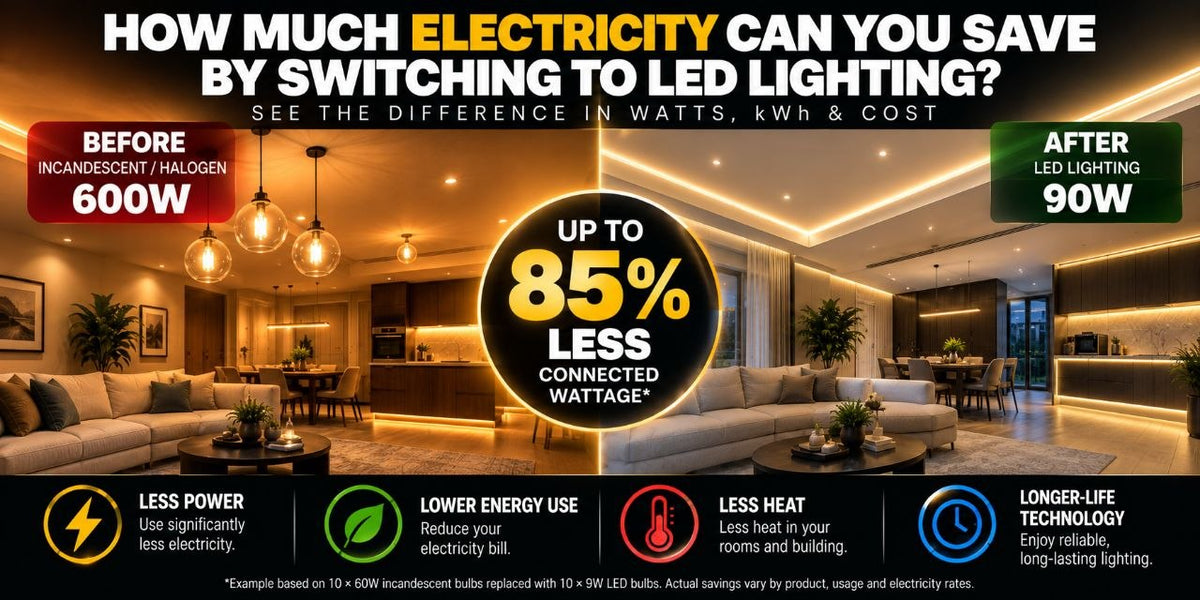
How Much Electricity Can You Save by Switching to LED Lighting?
One of the biggest reasons people switch to LED lighting is simple:
Lower electricity consumption.
Modern LEDs can produce useful light while consuming much less power than traditional incandescent lighting and, in many applications, less than halogen lighting.
But saying:
“LEDs save energy”
doesn't tell you very much.
The more useful question is:
How much electricity can you actually save?
The answer depends on four main factors:
Old Light Wattage
New LED Wattage
Hours Used
Electricity Rate
For a single lamp, the savings may look small.
But across:
- An entire home
- A retail store
- An office
- A restaurant
- A hotel
- A commercial property
the difference can become substantial.
Let's calculate it.
First: Why Do LEDs Use Less Electricity?
Traditional incandescent lamps produce light by heating a filament until it glows.
A large portion of the electrical energy becomes heat.
LEDs produce light using semiconductor technology and can deliver significantly more useful light for each watt of electrical power.
That's why an LED can often replace a much higher-wattage traditional lamp while producing a similar useful light level.
For example, depending on the products involved, a traditional:
60W incandescent bulb
might be replaced by an LED using roughly:
8–10W
for a broadly comparable lumen range.
That represents a major reduction in electrical power.
How Do You Calculate LED Energy Savings?
The basic calculation is simple.
Step 1 — Find the wattage difference
Old Wattage − LED Wattage = Watts Saved
For example:
60W − 9W = 51W saved
Step 2 — Multiply by operating hours
If the light operates:
5 hours/day
then:
51W × 5 = 255Wh/day
or:
0.255 kWh/day
Step 3 — Calculate annual savings
0.255 × 365 = 93.1 kWh/year
So replacing just one 60W lamp with a 9W LED could reduce annual electricity use by approximately:
93 kWh
if it operates five hours every day.
How Much Less Electricity Does That Use?
Using the same example:
60W Incandescent
At 5 hours/day:
0.060 kW × 5 × 365 = 109.5 kWh/year
9W LED
At 5 hours/day:
0.009 kW × 5 × 365 = 16.4 kWh/year
Difference:
109.5 − 16.4 = 93.1 kWh/year
In terms of connected wattage, the LED uses about:
85% less power
than the 60W lamp in this simplified comparison.
The exact savings depend on the actual products and equivalent delivered light.
Don't Compare Wattage Without Comparing Light Output
This is extremely important.
You should not compare:
60W incandescent
with:
20W LED
simply because they're both lamps.
You need to compare products providing an appropriate amount of usable light.
A better comparison uses:
Lumens
rather than assuming equal wattage means equal brightness.
Remember:
Watts
Measure electrical power.
Lumens
Measure visible light output.
LED efficiency allows you to produce a similar lumen output using fewer watts.
Every fixture in our recessed downlight range publishes both figures, so the comparison can be made on lumens rather than on wattage alone.
Example: Replacing 10 Incandescent Bulbs
Suppose a home has:
10 × 60W incandescent bulbs
Total connected load:
600W
Now replace them with:
10 × 9W LED bulbs
Total:
90W
Difference:
510W
If the lights operate for an average of:
5 hours/day
annual energy use becomes:
Incandescent
0.6 kW × 5 × 365 = 1,095 kWh/year
LED
0.09 kW × 5 × 365 = 164.25 kWh/year
Annual electricity reduction:
930.75 kWh
That's from only ten lamps.
What Does That Mean in Dollars?
To calculate cost savings:
kWh Saved × Electricity Rate = Electricity Cost Saved
Suppose your effective electricity price is:
$0.20/kWh
Using our 10-lamp example:
930.75 × $0.20 = $186.15/year
At:
$0.30/kWh
the same energy reduction would represent:
$279.23/year
Electricity rates vary considerably by location, provider, time of use, taxes, and other factors, so use your actual effective rate when estimating savings.
The LED Savings Formula
You can estimate annual energy savings with this formula:
Annual kWh Saved = (Old Watts − LED Watts) × Quantity × Hours/Day × 365 ÷ 1,000
Then:
Annual Cost Savings = Annual kWh Saved × Electricity Rate
For example:
Old Lights = 50W
LED = 8W
Quantity = 20
Use = 6 hours/day
Calculate:
(50 − 8) × 20 × 6 × 365 ÷ 1,000
=
1,839.6 kWh saved per year
At $0.20/kWh:
1,839.6 × 0.20 = $367.92/year
This makes it easy to estimate savings for almost any project.
Incandescent vs. LED
Incandescent lighting generally offers one of the largest opportunities for energy reduction.
As a simplified example:
| Traditional Lamp | Example LED Replacement | Connected-Wattage Reduction |
|---|---|---|
| 40W | 6W | 85% |
| 60W | 9W | 85% |
| 75W | 11W | 85% |
| 100W | 15W | 85% |
These are illustrative examples, not universal replacement specifications.
Always compare:
Lumens + Beam Distribution + Application
when selecting an actual replacement.
Our own fixtures sit close to these wattages: the 3-inch at 6W, the 4-inch at 9W and the 6-inch at 12W.
Halogen vs. LED
Halogen lighting is more efficient than traditional incandescent technology in some respects, but LED can still offer significant energy savings.
Imagine replacing:
50W halogen downlight
with an LED fixture consuming:
9W
Power reduction:
50 − 9 = 41W
Percentage reduction:
41 ÷ 50 × 100 = 82%
Again, actual equivalent products must be selected based on light output and application.
That 9W figure is a real product: our 4-Inch 5CCT Flat Panel Downlight draws 9W at CRI 90, with selectable colour temperature from 2700K to 5000K.
Example: 20 Halogen Downlights
Suppose a home has:
20 × 50W halogen downlights
Total:
1,000W
or:
1kW
Replace them with:
20 × 9W LED downlights
Total:
180W
Difference:
820W
At 6 hours/day:
Halogen
1 × 6 × 365 = 2,190 kWh/year
LED
0.18 × 6 × 365 = 394.2 kWh/year
Annual reduction:
1,795.8 kWh
At $0.20/kWh:
$359.16/year
And that's only the direct lighting electricity calculation.
If the existing halogens sit in standard recessed cans, the 4-Inch 5CCT Retrofit drops straight into them at 10W and roughly 1,100 lumens, with a 6-inch version for larger housings.
LED Lighting Can Also Reduce Heat
Electricity used by lighting ultimately contributes heat to the space.
Traditional incandescent and halogen lighting can generate substantial heat.
Switching to lower-wattage LEDs reduces the electrical power being consumed by the lighting system, which can also reduce the amount of heat added to an interior.
This can be particularly noticeable in:
- Retail stores
- Restaurants
- Display cases
- Kitchens
- Small rooms
- Commercial buildings with many fixtures
Can LEDs Reduce Air-Conditioning Costs Too?
Potentially.
If lighting contributes less heat to an air-conditioned building, the cooling system may have less heat to remove.
The actual HVAC savings depend on:
- Climate
- Building design
- Lighting load
- Cooling efficiency
- Operating schedule
- Heating season
- Internal loads
So don't simply add a fixed percentage for cooling savings.
But in some commercial environments, reduced lighting heat can provide an additional benefit beyond direct lighting electricity savings.
What About Winter?
There is an important nuance.
In a heated building during winter, heat produced by inefficient lighting isn't necessarily completely “wasted” from a space-heating perspective.
However, electric resistance-like heat from lighting may not be the most economical way to heat a building compared with an efficient heating system such as a heat pump.
The overall effect depends on the building and climate.
For that reason, the cleanest comparison starts with:
Direct Lighting Electricity Consumption
and treats HVAC effects separately.
How Much Can LED Downlights Save?
Let's compare a simplified installation.
Existing
12 × 50W halogen
Total:
600W
New
12 × 9W LED downlights
Total:
108W
Power reduction:
492W
If used 5 hours/day:
0.492 × 5 × 365 = 897.9 kWh/year saved
At $0.20/kWh:
$179.58/year
For larger homes or commercial projects, the savings scale with the number of fixtures and operating hours.
Both canless and retrofit options are available across our downlight range in 3-inch, 4-inch and 6-inch apertures.
Commercial Buildings Can Save Much More
The longer lights operate, the greater the potential savings from reducing wattage.
Imagine a retail store with:
100 × 50W lights
Existing connected load:
5,000W = 5kW
Replace them with:
100 × 10W LED fixtures
New load:
1,000W = 1kW
Power reduction:
4kW
If the store operates:
12 hours/day
annual energy reduction:
4 × 12 × 365
=
17,520 kWh/year
At $0.20/kWh:
$3,504/year
This is why LED retrofits can be especially attractive in commercial environments.
Operating Hours Make a Huge Difference
Compare the same 500W power reduction.
2 Hours/Day
0.5 × 2 × 365 = 365 kWh/year
6 Hours/Day
0.5 × 6 × 365 = 1,095 kWh/year
12 Hours/Day
0.5 × 12 × 365 = 2,190 kWh/year
24 Hours/Day
0.5 × 24 × 365 = 4,380 kWh/year
Same equipment.
Completely different annual savings.
That's why commercial and 24/7 applications can often justify efficient lighting upgrades faster than low-use spaces.
What About LED Strip Lighting?
LED strips should be evaluated somewhat differently.
If you're installing a completely new architectural lighting feature, you're not necessarily “saving” electricity compared with an older lamp because the lighting didn't exist before.
But when replacing an existing lighting system, compare the total system wattage.
For LED strips, calculate:
Watts per Foot × Total Feet
For example:
4 W/ft × 25 ft = 100W
Then include any relevant system losses when doing a detailed energy analysis.
Our 10mm Indoor Dotless COB Strip is close to that example at 4.27 W/ft, so a 25ft run comes to about 107W.
LED Strip Efficiency Matters Too
Not every LED strip produces the same amount of light per watt.
Suppose:
COB Strip A
4 W/ft
400 lm/ft
Efficiency:
100 lm/W
COB Strip B
5 W/ft
350 lm/ft
Efficiency:
70 lm/W
Strip A produces more listed light while using less electricity.
That's why comparing only:
Watts per Foot
isn't enough.
Look at:
Lumens per Foot + Watts per Foot
together.
Worked from our published figures, the 6.5mm Ultra Slim comes out around 123 lm/W (225 lm/ft on 1.83 W/ft), the 10mm around 97 lm/W (415 lm/ft on 4.27 W/ft) and the 12mm Double-Row around 87 lm/W. The brightest strip is not the most efficient one per watt.
High-Efficiency LEDs Can Reduce Driver Requirements Too
If you can achieve the required light output using a lower-power strip, your total system load decreases.
For example:
Option A
100 ft × 6 W/ft = 600W
Option B
100 ft × 4 W/ft = 400W
If both solutions provide the lighting performance your project requires, Option B reduces connected load by:
200W
That can affect:
- Driver capacity
- Energy use
- Heat
- Wiring
- Electrical distribution
Efficiency influences the whole system.
The same applies in our range: 100ft of the 10mm strip is about 427W, while 100ft of the 12mm double-row is about 732W — a difference of roughly 300W, and a materially different driver requirement.
Don't Reduce Wattage So Much That Lighting Quality Suffers
Energy efficiency doesn't mean choosing the lowest-powered light available.
Imagine replacing bright kitchen lighting with LEDs that use very little electricity but don't provide enough illumination.
You've reduced energy consumption—but created a poor lighting design.
The goal is:
Required Light Output Using Less Power
not simply:
Lowest Possible Wattage
Compare:
- Lumens
- Lux at the work surface
- CRI
- Color temperature
- Beam distribution
- Dimming
- Wattage
together.
Lumens per Watt Is an Important Specification
The efficiency of a light source can be expressed as:
Lumens ÷ Watts = Lumens per Watt
For example:
Light A
800 lumens ÷ 60W = 13.3 lm/W
Light B
800 lumens ÷ 9W = 88.9 lm/W
Both produce 800 lumens in this simplified example.
But Light B requires dramatically less electrical power.
That's the fundamental energy advantage behind efficient LED lighting.
Every product page in our COB strip range and downlight range lists both lumens and wattage, so you can calculate lm/W before ordering rather than after.
Dimming Can Save Additional Electricity
After switching to LEDs, you may be able to reduce consumption further through appropriate dimming.
Imagine a dimmable LED system that doesn't need full output all evening.
You might use:
100% — Task Mode
60% — General Evening Lighting
20% — Late-Night Ambience
OFF — Empty Room
Actual power reduction with dimming depends on the driver and control system, but dimming can reduce unnecessary lighting output and energy use.
Our 5-in-1 dimmable drivers support TRIAC, ELV, MLV, 0–10V and PWM, so the dimming method can match whatever control the building already uses.
Controls Can Be Just as Important as Efficient LEDs
A highly efficient light that stays on in an empty room still consumes electricity.
Combining LED lighting with controls can improve overall efficiency.
Useful options include:
- Occupancy sensors
- Motion sensors
- Timers
- Smart schedules
- Daylight controls
- Dimmers
- Multi-zone controllers
The most efficient watt is often the watt you don't need to use.
Our LED controllers and remotes cover scheduling, zoning and app control, and the MiBoxer WL5 works with Tuya for automated schedules.
Example: LED + Occupancy Sensor
Suppose a storage room has:
100W of LED lighting
Without a sensor, employees accidentally leave it on:
12 hours/day
Energy:
0.1 × 12 × 365 = 438 kWh/year
With occupancy control, actual use falls to:
3 hours/day
Energy:
0.1 × 3 × 365 = 109.5 kWh/year
Additional reduction:
328.5 kWh/year
The LEDs were already efficient.
The control strategy made them even more effective.
What About Leaving LEDs On Because They're Efficient?
This is a common mistake.
People sometimes think:
“They're LEDs, so leaving them on doesn't matter.”
It still matters.
Suppose a complete LED system uses:
200W
Leaving it on unnecessarily for 10 hours/day uses:
0.2 × 10 = 2 kWh/day
Over a year:
730 kWh
Efficient lighting should still be turned off or dimmed when it isn't needed.
Calculate Your Own Savings
Use this simple worksheet.
Existing Lighting
Wattage per light: _____ W
Number of lights: _____
Hours per day: _____
LED Replacement
Wattage per light: _____ W
Then calculate:
Existing Annual Energy
Old Watts × Quantity × Hours/Day × 365 ÷ 1,000
LED Annual Energy
LED Watts × Quantity × Hours/Day × 365 ÷ 1,000
Annual kWh Savings
Existing kWh − LED kWh
Annual Dollar Savings
kWh Saved × Your Electricity Rate
This gives you a much more useful answer than relying on a generic percentage.
Example: Whole-Home LED Upgrade
Suppose a home has 30 lamps.
Existing Lighting
30 × 60W = 1,800W
LED Replacement
30 × 9W = 270W
Difference:
1,530W
Assume average use:
4 hours/day
Annual reduction:
1.53 × 4 × 365
=
2,233.8 kWh/year
At:
$0.20/kWh
annual direct electricity savings would be approximately:
$446.76
At:
$0.30/kWh
approximately:
$670.14
Again, these are simplified examples and actual savings depend on real usage and products.
Example: Restaurant
Restaurants can have long lighting hours.
Suppose an upgrade reduces lighting load from:
8kW
to:
3kW
Difference:
5kW
Operating:
14 hours/day
Annual reduction:
5 × 14 × 365
=
25,550 kWh/year
At $0.20/kWh:
$5,110/year
Long operating hours make efficiency improvements especially valuable.
Example: Retail Store
Suppose a store replaces:
- Halogen track lighting
- Display lighting
- Shelf lighting
- Accent lighting
and reduces connected lighting load by:
3kW
At:
12 hours/day
annual savings:
3 × 12 × 365
=
13,140 kWh/year
At $0.20/kWh:
$2,628/year
Then controls and scheduling may reduce consumption further.
A retrofit at that scale usually combines recessed downlights for the general layer with COB strips for shelf and display lighting.
Don't Forget Maintenance Savings
Electricity isn't the only potential benefit of LED lighting.
Longer-lasting LED products can also reduce the frequency of lamp replacement.
That can mean lower:
- Replacement-lamp costs
- Labor costs
- Maintenance interruptions
- Lift/equipment costs in high ceilings
These benefits can be especially important in commercial properties.
However, actual lifespan depends on:
- Product quality
- Operating temperature
- Driver quality
- Installation
- Operating hours
So maintenance savings should be estimated realistically.
LED Drivers Consume Power Too
For low-voltage LED strips and some fixtures, the LED driver is part of the system.
Drivers are not 100% efficient.
If a driver supplies:
100W to the LED load
it may draw somewhat more than 100W from the input, depending on its efficiency and operating conditions.
For simple consumer estimates, LED load wattage provides a useful starting point.
For professional energy calculations, consider:
Complete System Input Power
rather than only the nominal LED load.
Each product page in our drivers and transformers range lists the input and output specifications needed for that calculation.
Why Driver Efficiency Matters
Consider two hypothetical systems delivering the same LED output power.
A more efficient driver wastes less electrical energy as heat.
Across one small residential installation, the difference may be modest.
Across:
Hundreds of fixtures
operating:
12–24 hours/day
small efficiency differences can add up.
For commercial projects, evaluate the complete lighting system.
Our compact transformers and junction-box transformers are UL Listed and Class 2 throughout, which is the baseline worth insisting on for a commercial retrofit.
LED Lighting and Solar Systems
Lower lighting power can also be useful in buildings using:
- Solar panels
- Battery storage
- Backup power
- Off-grid systems
Reducing lighting demand means less electrical energy needs to be generated or stored.
For example, reducing a lighting load from:
600W
to:
150W
reduces instantaneous demand by:
450W
That can be particularly useful during battery operation.
Low-voltage strip systems suit this well, and a selectable driver such as the 60W 5-in-1 can be set to 12V or 24V to match the rest of the system.
How Quickly Does an LED Upgrade Pay for Itself?
You can calculate simple payback:
Upgrade Cost ÷ Annual Savings = Simple Payback Period
For example:
LED upgrade cost:
$1,000
Annual electricity savings:
$400
Simple payback:
$1,000 ÷ $400 = 2.5 years
After that point, continued electricity savings can contribute to the financial benefit of the project.
This simplified calculation doesn't include:
- Financing
- Maintenance savings
- Utility incentives
- Electricity-price changes
- HVAC effects
but it's a useful starting point.
Check for Utility Rebates
Depending on your location and project, utilities or energy-efficiency programs may sometimes offer incentives for qualifying LED upgrades.
This is particularly relevant for:
- Commercial properties
- Warehouses
- Retail stores
- Offices
- Industrial buildings
Programs change frequently, so check current local requirements before calculating your final project cost.
Many programs require listed products, and our downlights, strips and transformers are UL certified.
When Is Switching to LED Most Valuable?
The strongest energy-saving opportunities are generally where existing lighting is:
High Wattage
and operates:
Many Hours Per Day
For example:
High Potential
50W halogen operating 12 hours/day.
Lower Potential
A small traditional lamp operating 20 minutes per week.
Both can save electricity with LED.
But the first upgrade will produce much larger annual savings.
Prioritize the Highest-Use Lights First
If you don't want to replace everything at once, start with lighting that:
- Uses the most watts
- Operates the most hours
- Is difficult or expensive to maintain
- Adds unwanted heat
- Can benefit from better controls
This usually provides the fastest practical benefit.
In most homes that means the halogen downlights first — our 4-inch and 6-inch retrofits fit standard cans without rewiring the ceiling.
Quick Energy-Savings Example
Let's compare 20 lights running 6 hours/day.
| Lighting | Wattage Each | Total Load | Annual Energy |
|---|---|---|---|
| Traditional | 60W | 1,200W | 2,628 kWh |
| LED | 9W | 180W | 394 kWh |
| Savings | 51W each | 1,020W | 2,234 kWh/year |
At $0.20/kWh:
Approx. $447/year saved
At $0.30/kWh:
Approx. $670/year saved
The exact result depends on your actual lamps, operating schedule, and electricity rate.
How to Maximize LED Energy Savings
Switching to LED is only the first step.
For even better results:
Choose efficient LEDs
Compare lumens per watt.
Use the correct brightness
Don't overlight the space.
Add dimming
Reduce output when full brightness isn't needed.
Use occupancy sensors
Especially in temporary-use rooms.
Create lighting zones
Don't turn on an entire room when only one area needs light.
Use schedules
Turn decorative lighting off automatically.
Use daylight
Don't run artificial lighting unnecessarily when sufficient natural light is available.
Turn lights off
When nobody needs them.
In practice that is an efficient strip or fixture, a dimmable driver, a controller for scheduling, and a multi-output transformer where zones need separate feeds.
Final Thoughts
So, how much electricity can you save by switching to LED lighting?
There isn't one universal percentage.
But when an efficient LED replaces a much higher-wattage incandescent or halogen product while providing comparable useful light, the reduction in lighting electricity consumption can be substantial.
A simplified replacement such as:
60W incandescent → 9W LED
represents about an:
85% reduction in connected wattage
for that lamp.
Across dozens or hundreds of lights, those savings can become significant.
The easiest way to estimate your own savings is:
(Old Watts − LED Watts) × Quantity × Hours × Electricity Rate
The bigger the wattage reduction and the longer the lights operate, the greater the potential savings.
And for the best results, don't stop at switching to LED.
Combine efficient lighting with:
Dimming + Sensors + Scheduling + Zoning + Smart Controls
because the most efficient lighting system isn't simply one that uses fewer watts.
It's one that provides the right amount of light only when and where it's needed.
FAQ
How much electricity do LED lights save?
It depends on the products being compared. Replacing a high-wattage incandescent or halogen lamp with an LED providing comparable useful light can substantially reduce lighting electricity consumption.
Do LEDs really use 80% less electricity?
Some LED-versus-incandescent comparisons can produce reductions around 80% or more. For example, replacing 60W with 9W reduces connected wattage by 85%. Actual product equivalence should be based on light output and application.
How much does a 9W LED cost to run?
Multiply 0.009 kW by the number of operating hours and your electricity rate. At five hours/day, it uses approximately 16.4 kWh per year. Our 4-inch downlight is a 9W fixture.
How do I calculate LED savings?
Subtract LED wattage from existing wattage, multiply by the number of lights and operating hours, then convert watts to kilowatt-hours and multiply by your electricity rate.
Are LED lights cheaper to run than halogen lights?
LEDs can use substantially less electricity than comparable halogen lighting, depending on the products and required light output.
Do LED strips save electricity?
LED strips can be efficient, but energy use depends on watts per foot, total installed length, operating hours, driver efficiency, and controls. Our COB strip range publishes W/ft and lm/ft for each product.
Does dimming LED lights save electricity?
Compatible LED dimming systems can reduce power consumption when the light output is reduced, though the exact relationship depends on the system.
Should I leave LEDs on because they use little electricity?
No. LEDs still consume electricity whenever they're operating. Turning unnecessary lighting off provides additional savings.
Can switching to LED reduce air-conditioning costs?
Potentially. Lower-wattage lighting generally adds less heat to a conditioned space, which can reduce cooling loads in some buildings.
How can businesses calculate LED retrofit savings?
Compare the complete existing and proposed lighting-system input wattages, multiply the difference by annual operating hours, and then multiply the resulting kWh savings by the applicable electricity rate.