
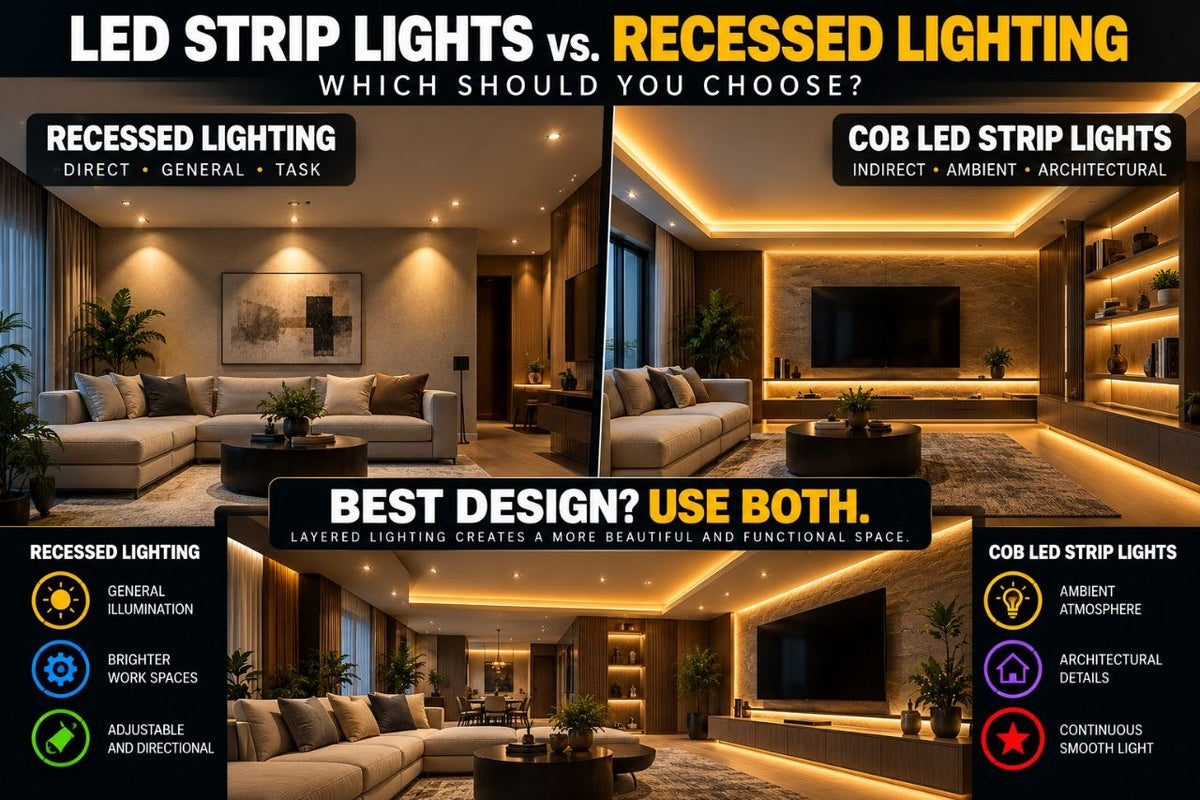
LED Strip Lights vs. Recessed Lighting: Which Should You Choose?
If you're planning lighting for a kitchen, living room, bedroom, hallway, or renovation, you may find yourself choosing between two popular options:
LED Strip Lights
and
Recessed LED Lighting
Which one is better?
The answer isn't simply one or the other.
These two types of lighting perform very different jobs.
Recessed lights typically provide direct illumination from the ceiling, while LED strips can create continuous linear, indirect, or architectural lighting.
In many well-designed interiors, the best solution is actually:
Recessed Lighting + COB LED Strip Lighting
Let's compare them so you can decide what makes sense for your space.
What Are LED Strip Lights?
LED strip lights are flexible linear lighting products containing LEDs mounted along a narrow circuit board.
They can be installed in places where conventional fixtures would be difficult or visually distracting.
Common applications include:
- Ceiling coves
- Under cabinets
- Shelves
- Closets
- Stairs
- Toe kicks
- TV walls
- Wall details
- Furniture
- Architectural channels
Modern COB LED strips are especially useful for architectural lighting because they create a much smoother, more continuous line of light than traditional strips with widely spaced LED points.
This makes them ideal when you want the light itself to feel integrated into the architecture.
Our COB LED strip range covers four widths from 6.5mm to 12mm, each in several colour temperatures.
What Is Recessed Lighting?
Recessed lights are installed into or against the ceiling so that the fixture remains relatively unobtrusive.
Modern LED downlights are available in many forms, including:
- Slim downlights
- Retrofit downlights
- Adjustable downlights
- Directional fixtures
- Multiple sizes
- CCT-selectable fixtures
Common sizes include:
4-inch
and
6-inch
although other sizes are also available.
Unlike LED strips, recessed lights usually create individual pools or beams of light rather than one continuous line.
Our recessed downlight range includes all six of those forms — the 4-inch and 6-inch slim flat panels, retrofit versions for existing cans, and a gimbal model with 90° tilt, all 5CCT selectable.
The Biggest Difference: Direct vs. Indirect Light
This is the most important difference.
Recessed Lighting
Usually provides:
Direct Light
The fixture sends light downward into the room.
LED Strip Lighting
Can provide:
Direct or Indirect Light
but is especially effective when hidden inside:
- Cove details
- Channels
- Cabinets
- Shelves
- Architectural features
so the light reflects from another surface.
This creates two completely different visual effects.
Quick Comparison
| Feature | COB LED Strip Lights | Recessed LED Lights |
|---|---|---|
| General room lighting | Good in some designs | Excellent |
| Task lighting | Excellent in specific locations | Excellent |
| Cove lighting | Excellent | Not suitable |
| Under cabinets | Excellent | Usually not practical |
| Accent lighting | Excellent | Very good |
| Continuous light | Yes | No |
| Directional lighting | Limited / depends on channel | Excellent with adjustable fixtures |
| Architectural effect | Excellent | Good |
| Minimal ceiling appearance | Excellent when hidden | Excellent |
| Layered lighting | Excellent | Excellent |
| Dimming | Available | Available |
| Installation complexity | Depends on application | Depends on ceiling/project |
Neither wins every category.
Which Is Better for General Lighting?
For conventional general room illumination, recessed lighting is often the more straightforward solution.
A properly designed recessed-light layout can distribute useful light throughout:
- Kitchens
- Living rooms
- Hallways
- Bathrooms
- Basements
- Offices
Because downlights illuminate the room directly from above, they can provide predictable general illumination.
LED strips can also contribute significant light, but indirect strip lighting behaves differently.
Can LED Strips Be the Main Light Source?
Sometimes.
A sufficiently bright COB LED strip system installed in a well-designed cove can produce substantial illumination.
But there is an important difference.
With indirect lighting, the LED strip first illuminates another surface—often the ceiling or wall—and that reflected light then enters the room.
The result can be:
Soft + Diffuse + Comfortable
but it may not provide the same concentrated task illumination as downlights.
Whether strip lighting can serve as the primary source depends on:
- Lumens per foot
- Total strip length
- Room size
- Ceiling height
- Surface reflectance
- Cove geometry
- Driver capacity
- Desired illumination level
Don't assume that every LED strip can replace ceiling fixtures.
If the cove is genuinely expected to light the room, that calls for the top of the range — our 12mm Double-Row COB Strip at 545–635 lm/ft, rather than a decorative strip at 200 lm/ft.
Which Creates Better Ambience?
For ambience, LED strips usually have the advantage.
Imagine a living room with a hidden COB strip around a ceiling cove.
You don't see the LEDs.
Instead, you see:
A soft glow spreading across the ceiling.
This can make the room feel:
- Warmer
- Softer
- More relaxing
- More architectural
- More luxurious
Recessed lighting can be dimmed to create ambience, but the visual effect remains different because the light originates from individual ceiling fixtures.
For a residential cove, the 8mm Indoor Dotless COB Strip is the usual starting point, with the 10mm for larger rooms or darker ceilings.
Which Is Better for Task Lighting?
It depends on the task.
Kitchen Countertop
Under-cabinet COB strip → Excellent
because the light is close to the work surface. The 10mm Indoor Dotless at 340–415 lm/ft is sized for this.
Kitchen Floor / General Workspace
Recessed downlights → Excellent
Desk
Either may work depending on placement.
Bathroom Vanity
Dedicated vanity lighting may be more appropriate than relying solely on either option.
Reading Area
A directional recessed fixture can help, but a dedicated reading lamp may provide more precise task illumination. A gimbal downlight tilts up to 90° to aim light where it is wanted.
The correct answer depends on where the task occurs.
Kitchen: LED Strips or Recessed Lights?
A kitchen is one of the clearest examples of why you often shouldn't choose only one.
Consider three layers.
Layer 1 — Recessed Downlights
Provide general room illumination. A 4-inch 5CCT flat panel is the common choice.
Layer 2 — Under-Cabinet COB
Provides direct countertop task lighting — typically the 10mm COB strip.
Layer 3 — Cove / Toe-Kick / Shelf Lighting
Adds ambience and architectural detail. The 1800K Golden Yellow strip suits a toe kick, and the 6.5mm Ultra Slim fits shelf reveals.
Together, these create a much more flexible kitchen than either system alone.
Why Recessed Lights Alone May Not Be Enough in a Kitchen
Imagine standing at your countertop.
The ceiling downlight is behind you.
Your body may partially block the light and create a shadow on the work surface.
Under-cabinet COB lighting solves this by placing the source directly above the countertop.
That's why a kitchen can benefit from:
Recessed + Under-Cabinet Lighting
rather than simply installing more downlights.
Why LED Strips Alone May Not Be Enough
Now consider the opposite.
You install beautiful under-cabinet and cove lighting but no strong general illumination.
The countertop may look great while the center of the kitchen feels too dark.
Again, combining lighting types can solve the problem.
Each layer has a different job.
Living Room: Which Is Better?
For living rooms, the answer depends heavily on the desired atmosphere.
Recessed lighting works well for:
- General illumination
- Artwork
- Furniture areas
- Circulation
- Adjustable accent lighting
COB strips work well for:
- Ceiling coves
- TV walls
- Shelves
- Built-ins
- Wall details
- Indirect illumination
A strong living-room design might use:
Recessed Lights → General
Cove COB → Ambient
Adjustable Downlights → Accent
This gives you multiple lighting scenes.
In products: 6-inch flat panels overhead, the 8mm COB in the cove, and gimbal downlights aimed at artwork.
Bedroom: LED Strip or Recessed?
Bedrooms generally benefit from softer lighting than kitchens.
Too many bright recessed lights can make a bedroom feel more like an office.
COB strip lighting can create softer illumination around:
- Ceiling coves
- Headboards
- Floating furniture
- Closets
- Shelves
Recessed lights can still provide useful general lighting.
A good combination might be:
Recessed Downlights → Cleaning / General Use
Cove Lighting → Evening
Bedside Lighting → Reading
This gives the room flexibility throughout the day.
For the evening layer, the 1800K Golden Yellow strip is considerably warmer than standard 2700K, and our 4-inch downlight with night light has a soft night mode built into the fixture.
Bathroom: Which Should You Choose?
Bathrooms need functional lighting.
Recessed lights can provide useful general illumination, while LED strips may be used for:
- Vanity accents
- Niches
- Under floating vanities
- Architectural details
However, bathroom lighting must be selected and installed for the environmental conditions and applicable electrical requirements.
A standard indoor strip is not automatically suitable for wet or damp locations.
Where humidity is a genuine concern, see our IP-rated outdoor strips and IP65 transformers.
Hallways
Hallways often work well with recessed downlights because they provide straightforward illumination along the path.
But COB strips can create dramatic alternatives.
For example:
Wall Wash
Baseboard Lighting
Ceiling Cove
Low-Level Night Lighting
If the goal is simple functionality, recessed lighting may be easier.
If the hallway is part of the architectural design, strip lighting can add much more visual interest.
For wall washing specifically, the 12mm Double-Row has the output to light a full wall evenly; the 3-inch downlight suits a narrow corridor where a 4-inch aperture would feel heavy.
Stairs
LED strips have a major advantage for stairs.
They can be integrated:
- Under stair nosings
- Beneath handrails
- Along walls
- Inside channels
- Along baseboards
This allows low-level illumination exactly where it is needed.
Recessed wall or ceiling fixtures can also work, but strips provide a continuous architectural effect that individual downlights cannot duplicate.
Because each tread needs its own short segment, the Cuttable Free-Cut COB Strip has much shorter cut intervals than a standard strip.
Which Is Better for Low Ceilings?
Both can work very well.
Slim LED downlights require very little visual space and can provide strong general illumination.
Indirect COB lighting can make a low ceiling feel visually softer because the ceiling itself becomes illuminated.
But you need enough architectural space to hide the strip properly.
In some low-ceiling rooms:
Slim Downlights + Perimeter COB
can create an excellent combination.
Our slim flat panel downlights are canless and need minimal plenum depth, and the 6.5mm Ultra Slim strip fits reveals too shallow for a wider strip.
Which Looks More Modern?
Both can look modern when installed correctly.
Recessed Lighting
Creates a clean ceiling with minimal visible fixtures.
COB Strip Lighting
Creates continuous architectural lines and hidden illumination.
If you're looking for a highly contemporary or luxury effect, concealed COB lighting often provides the visual detail that traditional downlights alone cannot create.
But too much strip lighting can also make a room look overly decorative.
Balance matters.
Don't Put LED Strips Everywhere
Because LED strips are flexible, it's tempting to install them:
Everywhere.
Ceiling.
Walls.
Cabinets.
Floor.
TV.
Shelves.
Stairs.
Furniture.
But more lighting features do not automatically create better lighting.
Use strip lighting where it serves a purpose:
- Task
- Accent
- Indirect illumination
- Architectural definition
- Navigation
Good lighting design also needs darkness and contrast.
Don't Install Too Many Recessed Lights Either
The same problem occurs with downlights.
A ceiling covered with a perfectly uniform grid of recessed fixtures can make a residential room feel overly commercial.
Instead of asking:
“How many downlights can I fit?”
ask:
“Where do I actually need light?”
This often produces a better layout.
Recessed Lighting and Beam Angle
Recessed lights have a major advantage:
Beam control.
Depending on the fixture, you can choose or work with different beam distributions.
A narrower beam can emphasize:
- Artwork
- Furniture
- Architectural details
A wider beam can provide broader general illumination.
Adjustable downlights can also direct the beam toward specific areas.
LED strips create a different type of distribution.
This is where the gimbal downlight earns its place — it tilts up to 90°, which a fixed flat panel cannot do.
COB Strips and Continuous Light
COB strip lighting's strength is continuity.
Instead of:
Light → Gap → Light → Gap
you get a smooth linear source.
This is particularly attractive for:
- Cove lighting
- Under cabinets
- Shelves
- Linear architectural channels
When used with an appropriate diffuser and channel, the result can look like an integrated light fixture.
What About Visible LED Dots?
Traditional LED strips can sometimes produce visible points of light, especially when:
- The diffuser is shallow
- The strip has wider LED spacing
- The reflective surface reveals the individual LEDs
COB strips dramatically reduce this issue because the emitting surface is much more continuous.
For this reason, COB is often the better choice for premium architectural strip-lighting installations.
Every white strip we carry is a dotless COB design — see the full range.
Aluminum Channels Matter
A quality strip-light installation is not only about the LED strip.
An aluminum channel can provide:
- Clean mounting
- Physical protection
- Better alignment
- Diffuser support
- Heat spreading
- Professional appearance
Different profiles can also change how the light is distributed.
You can use:
- Surface channels
- Recessed channels
- Corner channels
- Plaster-in channels
- Cove profiles
This gives strip lighting tremendous architectural flexibility.
Installation: Which Is Easier?
There isn't one universal answer.
Recessed Lighting
Installation may require:
- Ceiling openings
- Electrical wiring
- Junction boxes or integrated boxes
- Fixture spacing
- Ceiling access
Slim fixtures can make some installations easier than traditional recessed cans.
LED Strips
Installation may require:
- Driver location
- Low-voltage wiring
- Channels
- Cutting
- Connections
- Power injection for longer runs
- Concealing the strip
- Dimming/controller setup
A short under-cabinet strip can be relatively simple.
A 100-foot architectural cove can be a much more involved system.
Our slim panel downlights ship with an integrated junction box, which removes one step from the recessed side.
Renovation vs. New Construction
During new construction, you can plan both systems before walls and ceilings are finished.
This makes it easier to incorporate:
- Recessed fixture locations
- Cove details
- Driver access
- Wiring routes
- Channels
- Controls
During a renovation, existing conditions may influence your choice.
For example, if opening the ceiling is difficult, certain surface or architectural strip-lighting solutions may be easier to incorporate.
Where the existing cans can stay, the 4-inch and 6-inch retrofits drop into standard housings without cutting the ceiling.
Which Costs More?
It depends entirely on the project.
A simple LED strip installation may require:
COB Strip + Driver + Wiring
But a high-end architectural installation might require:
COB Strip + Dimmable Driver + Aluminum Channel + Diffuser + Controller + Custom Cove + Installation Labor
Likewise, recessed lighting costs depend on:
- Fixture quality
- Number of fixtures
- Ceiling access
- Wiring
- Dimmers
- Labor
So neither technology is automatically cheaper.
Compare the complete installed system, not just the fixture price.
For the strip side, the two line items to price together are the strip and a driver sized to the total load.
Energy Efficiency
Both LED strip lights and modern recessed LED fixtures can be energy efficient.
But you should not assume that one is always more efficient simply because of its format.
Compare:
Lumens
Watts
and:
Lumens per Watt
For strips, also consider the complete system including the LED driver.
For recessed fixtures, evaluate the actual fixture input power.
Both our strips and downlights publish lumens and watts on every product page, so the comparison can be made directly rather than assumed.
More Light Isn't Always More Efficient
Suppose you install:
300W of LED strips
to create a lighting effect that could have been achieved with:
150W
of properly positioned lighting.
The fact that the strips are LEDs doesn't make the first design efficient.
Lighting efficiency is about:
Providing the required light with appropriate energy use.
Good placement matters.
Dimming
Both systems can be dimmable.
Recessed Lights
May use compatible:
- Phase-cut dimmers
- 0–10V systems
- Smart controls
depending on the fixture.
LED Strips
May use:
- Dimmable LED drivers
- TRIAC/ELV/MLV-compatible drivers
- 0–10V drivers
- Low-voltage controllers
- Smart controllers
depending on the system.
Always verify compatibility between the lighting product, driver, and dimmer.
Our 5-in-1 dimmable drivers accept all five of those methods in a single unit, which keeps the strip side compatible with whatever dimmer the downlights are already on.
Use Separate Lighting Zones
One of the best ways to combine strips and downlights is to control them separately.
For example:
Zone 1
Recessed Downlights
Zone 2
Ceiling Cove COB
Zone 3
Under-Cabinet COB
Zone 4
Shelf Lighting
Now you can create different scenes.
Three strip zones need three feeds — a 288W Triple-Output Transformer provides them from one enclosure, or a 192W Dual-Channel where only two are needed.
Example: Kitchen Lighting Scenes
Cooking
Downlights — 100%
Under-Cabinet — 100%
Cove — 40%
Dinner
Downlights — 40%
Under-Cabinet — 40%
Cove — 60%
Late Evening
Downlights — OFF
Under-Cabinet — 20%
Cove — 30%
One room can feel completely different without changing a single fixture.
Example: Living Room Scenes
Everyday
Downlights — 60%
Cove — 40%
Entertaining
Downlights — 40%
Cove — 70%
Shelf Lighting — 50%
Movie
Downlights — OFF
Cove — 10%
TV Backlighting — 10%
This is the real advantage of layered lighting.
Scenes like these are easier to automate with a controller than with wall dimmers alone — see our LED controllers and remotes.
Color Temperature
Both recessed lights and COB strips are available in different color temperatures.
Common choices include:
2700K — Warm
3000K — Warm/Neutral
4000K — Neutral/Crisp
5000K — Cooler
For residential interiors, consistency matters.
If your downlights are:
3000K
and your cove lighting is:
5000K
the difference may look unintentional.
For many designs, matching or intentionally coordinating color temperatures creates a cleaner result.
This is simpler than it sounds with our range: the 8mm and 10mm strips come in 2700K, 3000K, 4000K and 5000K, and the downlights are selectable across all five, so the ceiling can simply be set to match the strip.
CCT-Selectable Lighting
Some downlights allow you to select among multiple color temperatures during installation.
You can also find adjustable or tunable-white LED strip systems.
This can provide more flexibility when you're unsure which CCT works best with:
- Paint
- Cabinets
- Flooring
- Furniture
- Stone
But always confirm that the driver and control system are compatible with the selected LED technology.
On the strip side that means the CCT COB Strip with a CCT driver with built-in controls, which handles colour temperature and brightness from one unit.
CRI Matters Too
Color temperature tells you whether the light appears warm or cool.
CRI relates to how accurately colors appear under the light.
For spaces such as:
- Kitchens
- Bathrooms
- Closets
- Retail displays
- Artwork areas
high-quality color rendering can make a noticeable difference.
A 90+ CRI product can be a good choice for many residential applications.
But remember:
COB does not automatically mean high CRI.
Check the actual product specification.
Ours are CRI 90 on both sides — across the COB strip range and the downlight range — so mixing the two does not introduce a colour-rendering mismatch.
Maintenance
Recessed fixtures and LED strip systems both eventually require service.
With recessed lighting, this might mean replacing:
- Fixture
- Driver
- Module
depending on the design.
With strip lighting, service may involve:
- Strip
- Driver
- Controller
- Connector
This is why accessibility matters.
Don't permanently bury LED drivers or other serviceable components where they cannot be reached.
Because strips and drivers are sold separately, a failed driver means replacing one component rather than an entire run of strip.
What Happens If a Strip Fails?
A long strip-lighting installation may be divided into sections.
If one section develops a problem, troubleshooting may involve checking:
- Driver
- Wiring
- Connections
- Controller
- Voltage
- Individual strip section
Properly planned installations make these components accessible.
What Happens If a Recessed Light Fails?
Depending on the fixture design, a failed recessed LED may require replacing:
- The LED module
- Driver
- Complete fixture
Choose products that make future service practical.
This matters particularly when installing dozens of fixtures.
Which Is Better for Luxury Interiors?
For higher-end interiors, the answer is often:
Both
Recessed lights provide controlled functional illumination.
COB strips provide architectural depth.
Imagine a luxury living room with:
Adjustable Downlights
highlighting artwork,
plus:
Hidden 2700K COB Cove Lighting
washing the ceiling,
plus:
COB Shelf Lighting
inside custom cabinetry.
Each system performs a different role.
The result is much richer than using one lighting type everywhere.
That exact specification is available: a gimbal downlight for the artwork, the 8mm COB in 2700K for the cove, and the 6.5mm Ultra Slim inside the shelving.
Which Should You Choose?
Use this simple guide.
Choose Recessed Lighting When You Need:
- General room illumination
- Direct downward lighting
- Strong task illumination
- Adjustable directional light
- A clean ceiling appearance
- Simple individual fixtures
Browse the recessed downlight range.
Choose COB LED Strips When You Need:
- Cove lighting
- Under-cabinet lighting
- Continuous linear illumination
- Shelf lighting
- Architectural accents
- Hidden indirect lighting
- Furniture integration
- Decorative effects
Browse the COB LED strip range.
Choose Both When You Want:
- Layered lighting
- Flexible lighting scenes
- Task + ambient lighting
- High-end architectural design
- Better control over the room atmosphere
Room-by-Room Recommendation
| Room | Recessed Lighting | COB Strip Lighting |
|---|---|---|
| Kitchen | Excellent | Excellent |
| Living Room | Excellent | Excellent |
| Bedroom | Very Good | Excellent for ambience |
| Bathroom | Excellent | Good for accents |
| Hallway | Excellent | Good for architectural effects |
| Stairs | Good | Excellent |
| Closet | Very Good | Excellent |
| Home Theater | Good | Excellent for ambience |
| Office | Excellent | Good |
| Retail | Excellent | Excellent |
Common Mistakes to Avoid
Don't:
- Use recessed lights everywhere simply because they're easy to lay out
- Cover the ceiling with an excessive grid of downlights
- Use LED strips everywhere just because they look modern
- Expect low-output strips to provide all general illumination
- Install visible SMD dots in a premium architectural detail
- Mix color temperatures accidentally
- Ignore CRI
- Forget dimming compatibility
- Hide LED drivers where they cannot be serviced
- Ignore voltage drop on long strip runs
- Overload an LED driver
- Install outdoor or bathroom lighting without considering environmental ratings
- Design each lighting layer independently
Think of the entire room as one lighting system.
A Better Way to Design the Room
Instead of asking:
“LED strips or recessed lights?”
ask three questions.
1. Where Do I Need Functional Light?
Use appropriate task and general lighting.
2. Where Do I Want Visual Emphasis?
Use accent lighting.
3. Where Do I Want Atmosphere?
Use indirect and decorative lighting.
Then choose the lighting technology that performs each job best.
This is a much stronger approach than trying to make one fixture type do everything.
Final Thoughts
So, LED strip lights vs. recessed lighting—which should you choose?
For most projects:
Recessed lighting is better for direct general and task illumination.
COB LED strips are better for continuous, indirect, accent, and architectural lighting.
But the strongest answer is often:
Use Both
A well-designed lighting plan might use:
Recessed Downlights
for general illumination,
COB Under-Cabinet Lighting
for tasks,
and:
COB Cove Lighting
for ambience.
This gives you:
Function + Comfort + Architecture + Flexibility
Instead of thinking about lighting as a collection of individual fixtures, think about it in layers.
That's how you create a room that works beautifully during the day, at night, while working, while entertaining, and while relaxing.
You can plan the whole system in one place: recessed downlights, COB strips, and the drivers that run them.
FAQ
Are LED strip lights better than recessed lights?
Neither is universally better. Recessed lights are often better for general and direct illumination, while LED strips are particularly useful for continuous, indirect, task, and architectural lighting.
Can LED strips replace recessed lighting?
In some designs, yes, but not always. Whether strips can provide enough general illumination depends on their output, total length, placement, room size, surface reflectance, and lighting requirements. A high-output strip such as the 12mm Double-Row gives you the best chance of it.
Can I use LED strips and recessed lights together?
Yes. In fact, combining them is often one of the best ways to create layered lighting.
Which is better for a kitchen?
Both. Recessed lights can provide general illumination while under-cabinet COB strips provide focused countertop task lighting.
Which is better for a bedroom?
COB strips are excellent for soft ambient lighting, while recessed fixtures can provide stronger general illumination when needed.
Are COB LED strips better for architectural lighting?
COB strips are particularly useful when a smooth, continuous-looking line of light is desired.
Do LED strips use less electricity than recessed lights?
Not necessarily. Energy consumption depends on total system wattage and the amount of useful light produced.
Which is easier to install?
It depends on the application. A small under-cabinet strip can be straightforward, while a large architectural strip system can be complex. Recessed installation also varies based on ceiling access and wiring.
Should LED strips and downlights have the same color temperature?
They often look more cohesive when their color temperatures coordinate, although intentional differences can also be used in a lighting design. Our downlights are 5CCT selectable, so they can be set to match whichever strip you choose.
Should LED strips and recessed lights be on separate dimmers?
Separate zones are often useful because they allow you to control general, task, and ambient lighting independently. A multi-output transformer gives each strip zone its own feed.