
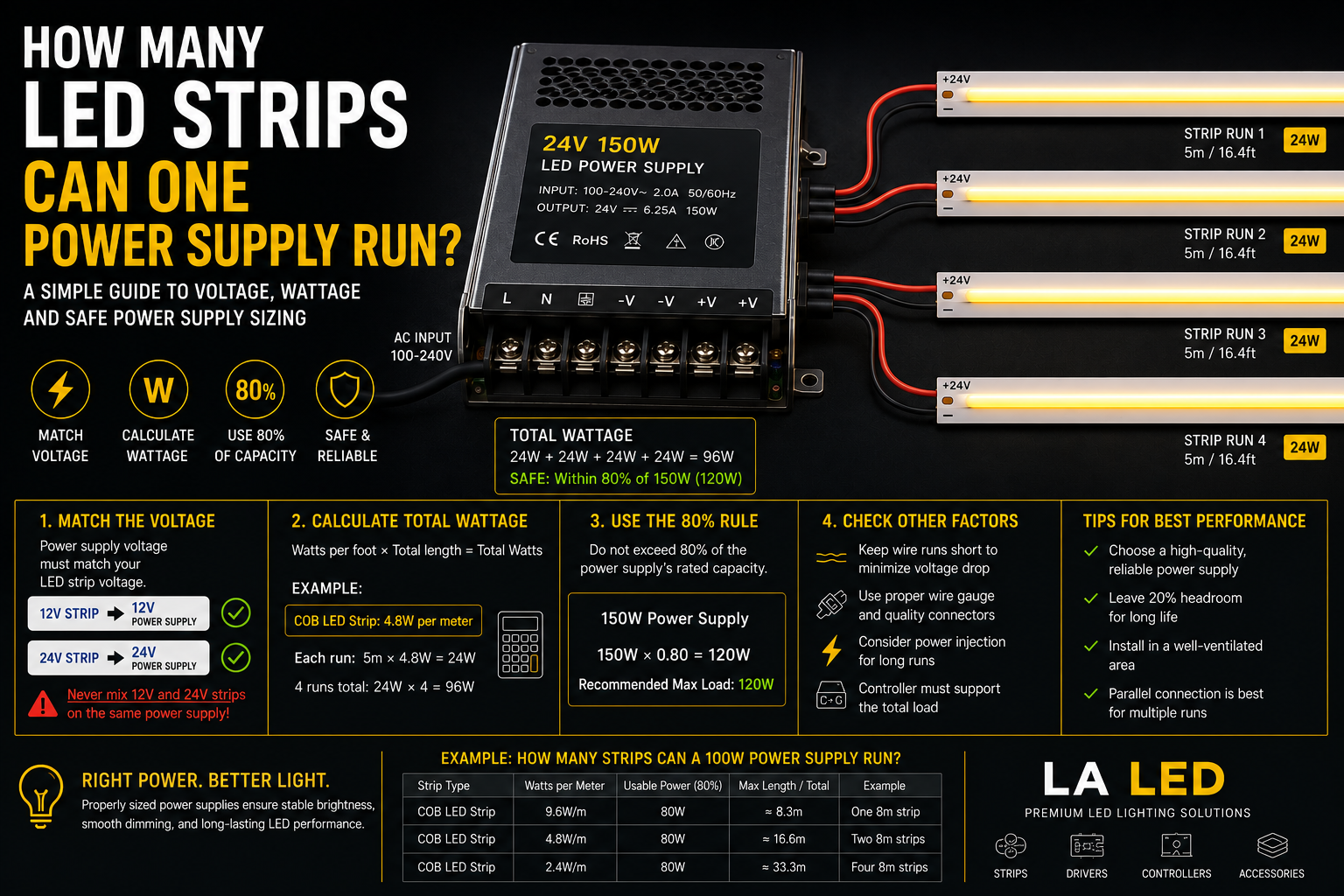
When planning an LED strip lighting project, one of the most common questions is: How many LED strips can one power supply run?
There is no single answer because the number depends on the voltage, wattage, and length of the LED strips, as well as the rated capacity of the power supply. A small driver may operate one short strip, while a larger power supply may run several separate LED strip sections.
The most important rule is that the combined wattage of all connected LED strips must remain safely below the maximum output of the power supply.
Start by Matching the Voltage
Before calculating wattage, make sure the output voltage of the power supply matches the operating voltage of the LED strip.
For example:
- A 12V LED strip requires a 12V power supply.
- A 24V LED strip requires a 24V power supply.
- Never connect a 12V strip directly to a 24V power supply.
- Do not mix 12V and 24V strips on the same constant-voltage output.
Matching voltage is essential for safe and reliable operation. Drivers that output either voltage, such as the 60W 5-in-1 Dimmable LED Driver (12V / 24V), remove the risk of ordering the wrong one for a small run.
Find the Wattage of Each LED Strip
LED strip power consumption is usually listed in watts per foot, watts per meter, or total watts per roll.
For example, imagine an LED strip consumes 4 watts per foot. A 10-foot section would use:
4 watts × 10 feet = 40 watts
Three separate 10-foot sections would consume:
40 watts × 3 = 120 watts
The power supply must be large enough to support the total connected load.
Use the 80% Loading Rule
It is generally best not to operate a power supply continuously at its full rated capacity. Leaving approximately 20% extra capacity helps the system run more reliably and provides room for normal variations in power consumption.
A simple guideline is:
Usable power supply capacity = Rated wattage × 0.80
For example:
- A 60W power supply provides approximately 48W of recommended usable capacity.
- A 100W power supply provides approximately 80W.
- A 150W power supply provides approximately 120W.
- A 200W power supply provides approximately 160W.
This does not mean the remaining capacity is wasted. The extra margin helps prevent overloading, overheating, flickering, and premature power supply failure.
Simple Calculation Formula
Use this formula to estimate the required capacity:
Total LED wattage = Watts per foot × Total strip length
Then calculate the recommended power supply size:
Required power supply wattage = Total LED wattage ÷ 0.80
For example, if your LED strips consume a combined total of 72 watts:
72 ÷ 0.80 = 90 watts
A power supply rated at least 90 watts would be needed. Since standard sizes may vary, choosing the next available size above the calculated requirement, such as 96W or 100W, would normally be appropriate. In that case a 100W 5-in-1 Dimmable LED Driver is the next size up, leaving about 80W of usable capacity against a 72W load.
Example: How Many Strips Can a 100W Power Supply Run?
Assume each LED strip section is 10 feet long and consumes 3 watts per foot.
Each strip uses:
10 feet × 3 watts = 30 watts
A 100W power supply has approximately:
100 watts × 0.80 = 80 watts of recommended usable capacity
Two 10-foot strips would use:
30 watts × 2 = 60 watts
Three strips would use:
30 watts × 3 = 90 watts
In this example, the 100W power supply can comfortably run two of the strips, but three would exceed the recommended 80% loading level. To run all three from a single unit, step up to a 150W 5-in-1 Dimmable LED Driver, which allows roughly 120W of usable capacity.
Can Multiple LED Strips Share One Power Supply?
Yes. Multiple LED strips can share one compatible power supply when:
- All strips use the same voltage.
- Their combined wattage remains within the recommended capacity.
- The wiring and connectors are properly sized.
- Each strip receives stable voltage.
- The controller, if used, can handle the total electrical load.
In many installations, separate LED strip sections are connected in parallel to the power supply or distribution wiring.
Parallel wiring allows each strip section to receive the correct voltage. Connecting long strip sections end-to-end may increase voltage drop and cause uneven brightness.
Power Supply Capacity Is Not the Only Limit
Even when a power supply has enough wattage, other factors can affect how many strips it can run successfully.
Voltage Drop
Long wire runs and long LED strip installations can lose voltage as electricity travels through the system. The far end of the strip may appear dimmer, change color, or operate inconsistently.
Using 24V LED strips, heavier-gauge wiring, shorter wire runs, or power injection can help reduce voltage drop.
Controller Capacity
RGB, RGBW, CCT, and smart LED systems often include a controller between the power supply and the strips. The controller has its own voltage, amperage, and wattage limits.
Even if the power supply is large enough, the controller may not be able to carry the full load. Always check the controller’s maximum output before connecting multiple LED strips.
Wire and Connector Ratings
Wires, connectors, splitters, and terminal blocks must be suitable for the total current of the system. A connector designed for a small strip section may not safely carry the load of several high-output strips.
Number of Power Supply Outputs
Some power supplies provide multiple output terminals. These terminals can make it easier to connect separate LED strip runs, but they do not increase the total available wattage.
For example, a 100W power supply remains a 100W power supply even when it has two or three output terminals. The combined load across all outputs must remain within its capacity.
Long LED Strip Runs Should Not Always Be Connected End-to-End
A common mistake is connecting several LED strip rolls in one continuous line from a single feed point.
Even when the driver has sufficient wattage, the strip itself may not be designed to carry the current required by a very long continuous run. This can create:
- Uneven brightness
- Color changes
- Voltage drop
- Excess heat
- Reduced LED lifespan
For larger installations, it is often better to divide the lighting into shorter parallel runs or provide power at multiple points.
12V vs 24V for Multiple LED Strips
Both 12V and 24V LED strips can share a properly sized power supply, but 24V systems are often preferred for longer lighting projects.
Compared with 12V systems, 24V LED strips generally experience less voltage drop over the same distance and can be easier to use in larger installations.
However, the power supply voltage must always match the strip voltage.
Signs That Your Power Supply Is Overloaded
An overloaded or undersized power supply may cause:
- Flickering or flashing
- Lights turning off unexpectedly
- Reduced brightness
- Unstable dimming
- Excessive heat
- Buzzing or unusual noise
- The power supply repeatedly restarting
If these symptoms occur, disconnect the system and verify the total connected wattage, voltage, wiring, and component compatibility.
Should You Use One Large Power Supply or Several Smaller Ones?
A single larger power supply may simplify some installations, but several smaller power supplies can sometimes be more practical.
One large power supply may work well when:
- The strips are located close together.
- Wiring distances are short.
- The total load is within capacity.
- The system has a suitable distribution plan.
For that kind of centralized layout, a 300W 5-in-1 Dimmable LED Driver with Junction Box gives roughly 240W of usable capacity and keeps all of the terminations in one enclosure.
Multiple power supplies may be better when:
- LED strips are installed in different rooms or distant locations.
- Long wire runs would create voltage drop.
- Separate lighting zones need independent control.
- The installation contains several high-wattage sections.
The best option depends on the layout and control requirements of the project.
Choose a Dimmable Power Supply When Needed
If you want to control brightness using a wall dimmer, select a dimmable LED driver that is compatible with both the LED strips and the dimming system.
A standard non-dimmable power supply should not be expected to operate correctly with a wall dimmer. Incompatible components may cause flickering, buzzing, limited dimming, or unstable performance. A driver like the 200W 5-in-1 Dimmable LED Driver accepts TRIAC, ELV, MLV, 0-10V, and PWM control, so it works with whichever dimming method the project uses.
Final Thoughts
The number of LED strips one power supply can run depends on the combined wattage of the strips—not simply the number of rolls or sections.
To size the system correctly:
- Match the power supply voltage to the LED strip voltage.
- Calculate the total wattage of every connected strip.
- Use approximately 80% of the power supply’s rated capacity.
- Check the ratings of controllers, wires, and connectors.
- Plan for voltage drop on long installations.
- Divide long projects into shorter powered sections when necessary.
A properly sized power supply helps your LED strips deliver stable brightness, smooth dimming, and reliable long-term performance.
FAQ
Can one power supply run multiple LED strips?
Yes. One power supply can operate multiple LED strips when they have the same voltage and their combined wattage stays within the recommended capacity.
How do I calculate the power supply size for LED strips?
Multiply the strip’s watts per foot by the total installed length. Divide the result by 0.80 to allow approximately 20% extra capacity.
Can I connect two full LED strip rolls to one power supply?
Possibly, but it depends on the wattage of each roll and the capacity of the power supply. Long rolls may also require parallel wiring or power injection to prevent voltage drop.
Can I connect 12V and 24V LED strips to the same power supply?
No. A constant-voltage power supply produces one output voltage. Use separate compatible power supplies for 12V and 24V strips.
Does a power supply with multiple outputs provide more wattage?
No. Multiple output terminals divide the available connection points but do not increase the power supply’s total wattage.
Why do my LED strips become dimmer at the far end?
The most likely cause is voltage drop. Shorter strip runs, thicker wiring, 24V strips, parallel connections, or power injection may help.
Can an oversized power supply damage LED strips?
A correctly regulated constant-voltage power supply with a higher wattage capacity does not force all available wattage into the strip. The voltage must match, and the installation must be properly protected and wired.