
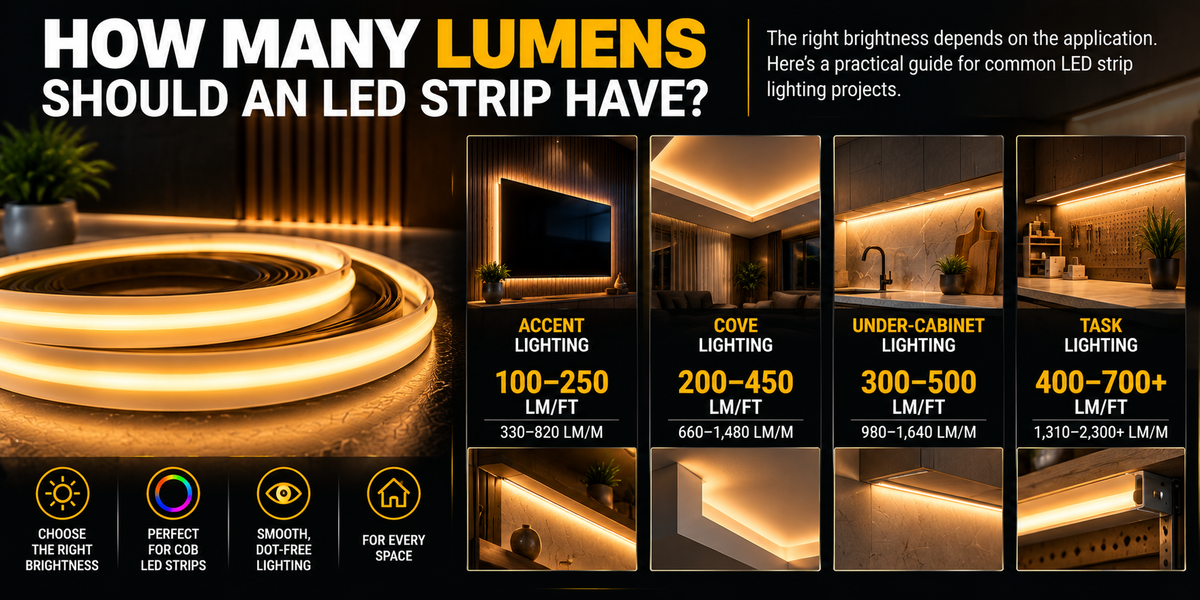
How Many Lumens Should an LED Strip Have?
When shopping for LED strip lights, you'll see specifications such as:
Watts per foot
LEDs per meter
Color temperature
CRI
and:
Lumens
But if you're trying to determine how bright the finished installation will actually be, lumen output is one of the most useful specifications to understand.
So how many lumens should your LED strip have?
There isn't one perfect number.
A strip used for subtle shelf lighting needs much less output than one used to illuminate a kitchen countertop.
As a practical starting point, you might consider approximately:
| Application | Starting Range |
|---|---|
| Decorative / Mood Lighting | 100–250 lm/ft (330–820 lm/m) |
| Shelf / Accent Lighting | 150–300 lm/ft (490–980 lm/m) |
| Cove Lighting | 200–450 lm/ft (660–1,480 lm/m) |
| Under-Cabinet Lighting | 300–500 lm/ft (980–1,640 lm/m) |
| Task Lighting | 400–700+ lm/ft (1,310–2,300+ lm/m) |
| High-Output Architectural Lighting | 500–800+ lm/ft (1,640–2,625+ lm/m) |
These are general starting ranges, not fixed requirements.
The right output depends on the room, mounting location, surfaces, diffuser, distance, and whether the strip is the primary or secondary light source.
Every strip in our COB LED strip range publishes its lumens per foot at each colour temperature, so you can match a product to these bands directly rather than estimating from wattage.
What Is a Lumen?
A lumen (lm) measures luminous flux—the quantity of visible light produced by a source.
In simple terms:
More lumens = more total visible light.
For LED strips, however, don't look only at the total lumens printed on the package.
You need to know the output relative to strip length.
That means comparing:
Lumens per Foot (lm/ft)
or:
Lumens per Meter (lm/m).
Lumens per Foot vs. Total Lumens
Suppose you have two 16.4-foot LED strips.
Strip A
200 lm/ft
Total theoretical output:
200 × 16.4 = 3,280 lumens
Strip B
500 lm/ft
Total theoretical output:
500 × 16.4 = 8,200 lumens
Both strips are the same length.
But Strip B produces substantially more light.
This is why strip length alone tells you almost nothing about brightness.
That gap is real across our own range: the 6.5mm Ultra Slim produces 200–225 lm/ft while the 12mm Double-Row produces 545–635 lm/ft. Same 16.4ft roll, roughly three times the light.
How Do You Convert Lumens per Foot to Lumens per Meter?
Because:
1 meter ≈ 3.281 feet
you can approximately convert:
lm/ft → lm/m
Lumens per Foot × 3.281
For example:
300 lm/ft × 3.281 ≈ 984 lm/m
And to convert the other direction:
lm/m → lm/ft
Lumens per Meter ÷ 3.281
For example:
1,000 lm/m ÷ 3.281 ≈ 305 lm/ft
This is useful when comparing LED strips from different manufacturers.
1. Decorative and Mood Lighting
If the LED strip is mainly decorative, you usually don't need extremely high output.
Think about:
- Bedroom headboards
- TV backlighting
- Floating furniture
- Decorative shelving
- Bar lighting
- Soft architectural accents
A starting range around:
100–250 lm/ft
or approximately:
330–820 lm/m
may be enough for many applications.
The purpose here isn't to illuminate the entire room.
It's to create:
Atmosphere + Depth + Visual Interest
Our 6.5mm Ultra Slim COB Strip sits in this band at 200–225 lm/ft depending on colour temperature.
2. Shelf and Display Lighting
Shelves usually need enough brightness to make objects visible without overwhelming the display.
A useful starting range might be:
150–300 lm/ft
or:
490–980 lm/m
Actual requirements depend heavily on:
- Shelf depth
- Strip position
- Surface color
- Distance to objects
- Diffuser
- Desired contrast
A dark display cabinet may need more output than a white one because darker surfaces reflect less light.
Both the 6.5mm Ultra Slim (200–225 lm/ft) and the 8mm Indoor Dotless (250–270 lm/ft) fall inside this range, with the 8mm at the brighter end for darker cabinetry.
3. Cove Lighting
Cove lighting is different because the LED strip is often hidden.
The light first hits:
Ceiling or Wall
and then reflects into the room.
This means not all of the strip's output reaches the occupied space directly.
A common starting range might therefore be:
200–450 lm/ft
or approximately:
660–1,480 lm/m
For large rooms, high ceilings, or cove lighting intended to contribute significantly to general illumination, higher output may be useful.
Two products cover this band. The 8mm Indoor Dotless at 250–270 lm/ft suits a typical residential cove, while the 10mm Indoor Dotless at 340–415 lm/ft sits at the upper end for larger rooms, higher ceilings or darker finishes. Beyond that band, the 12mm Double-Row at 545–635 lm/ft is for a cove doing real work as the room's ambient light.
Why Does Cove Lighting Sometimes Look Too Dim?
You may buy a reasonably bright strip but still find the finished cove disappointing.
Possible reasons include:
- Strip too deep inside the cove
- Dark ceiling
- Poor reflection angle
- Low lumen output
- Large room
- High ceiling
- Diffuser losses
- Excessive distance from reflective surface
- Voltage drop
The strip specification is only one part of the lighting result.
4. Under-Cabinet Lighting
Kitchen countertops require more useful illumination than decorative shelves.
A practical starting range for many under-cabinet applications might be:
300–500 lm/ft
or approximately:
980–1,640 lm/m
However, don't choose brightness in isolation.
The finished countertop illumination depends on:
Strip Output + Mounting Position + Cabinet Height + Countertop Reflectance + Diffuser + Other Room Lighting
Our 10mm Indoor Dotless COB Strip is the product built for this band — 340 lm/ft in 2700K rising to 415 lm/ft in 5000K, at CRI ~90, which lands squarely in the under-cabinet range. For a deep counter, very dark stone, or a kitchen where the under-cabinet run is the main task light, the 12mm Double-Row at 545–635 lm/ft gives you headroom and dims back down for evening use.
Where Should Under-Cabinet COB Strip Be Installed?
If the strip is mounted too close to the back wall, much of the light may emphasize the backsplash rather than the work surface.
Moving the channel toward the front portion of the cabinet can often distribute more useful light across the countertop.
The exact position depends on the cabinet and lighting design.
This is why two kitchens using the exact same COB strip can appear very different.
5. Task Lighting
When LED strip lighting is being used for actual visual tasks, brightness becomes more important.
Examples include:
- Workbenches
- Kitchen preparation areas
- Workstations
- Utility counters
- Hobby spaces
You may consider approximately:
400–700+ lm/ft
or:
1,310–2,300+ lm/m
depending on the task and installation.
For task lighting, the better design target is ultimately illumination on the work surface, usually measured in lux or foot-candles—not simply strip lumens.
The 12mm Double-Row High-Brightness COB Strip is the product in our range built for this tier, at 545 lm/ft in 2700K rising to 635 lm/ft in 5000K. At the lower end of the band, the 10mm reaches 415 lm/ft in 5000K.
Lumens and Lux Are Not the Same
This is important.
Lumens measure how much visible light the source produces.
Lux measures how much light reaches a surface.
One lux equals:
1 lumen per square meter.
So a 1,000-lumen light source doesn't automatically create the same illumination everywhere.
Its effect depends on:
- Distance
- Beam distribution
- Direction
- Reflection
- Surface area
- Fixture design
This is why lumens alone cannot completely predict the finished lighting result.
6. High-Output Architectural Lighting
Some LED strip installations are intended to contribute substantially to general room illumination.
These might use:
500–800+ lm/ft
or:
1,640–2,625+ lm/m
depending on the product and project.
Applications might include:
- Large coves
- Commercial spaces
- Architectural linear lighting
- High-output recessed channels
- Large ceiling features
High-output strips require greater attention to:
Heat Management
Driver Sizing
Voltage Drop
and:
Aluminum Channels
because higher output often comes with higher electrical power.
The 12mm Double-Row draws 7.32W/ft against the 8mm strip's 3.05W/ft, so a run of it needs roughly two and a half times the driver capacity for the same length.
Does More Watts Mean More Lumens?
Generally, increasing electrical power can allow greater light output—but wattage alone does not tell you brightness.
Two strips might both consume:
5W/ft
but one could produce more lumens because it is more efficient.
A useful metric is:
Lumens per Watt (lm/W)
For example:
Strip A
500 lumens using 5 watts:
100 lm/W
Strip B
350 lumens using 5 watts:
70 lm/W
Strip A produces more visible light for the same electrical power.
So don't compare LED strips using wattage alone.
Our own published figures show this clearly. The 6.5mm Ultra Slim delivers roughly 225 lm/ft on 1.83W/ft — about 123 lm/W — while the far brighter 12mm Double-Row delivers 635 lm/ft on 7.32W/ft, about 87 lm/W. The brighter strip is the less efficient one per watt; it simply uses far more power.
Does LED Density Determine Brightness?
Not necessarily.
This is another common misunderstanding.
A COB strip with a higher chip density isn't automatically brighter than every strip with a lower density.
LED density can influence:
- Light continuity
- Dot-free appearance
- Distribution
- Thermal characteristics
But actual brightness depends on the strip's lumen output and electrical design.
When brightness matters, check:
lm/ft or lm/m
rather than relying only on:
LEDs/m.
A direct example from our range: the RGB COB Strip packs 630 LEDs/m yet produces about 210 lm/ft, while the 10mm Indoor Dotless uses only 480 LEDs/m and produces 340–415 lm/ft. Higher density, considerably less light.
COB vs. SMD: Which Is Brighter?
Neither technology is automatically brighter simply because of its name.
Brightness depends on the specific product.
However, COB LED strips are especially useful for architectural applications because they can create a smooth, continuous line of light with minimal visible spotting.
This makes COB particularly attractive for:
- Cove lighting
- Under-cabinet lighting
- Shelving
- Aluminum profiles
- Recessed channels
- Linear architectural lighting
Compare actual lumen specifications rather than assuming one technology always produces more light.
Does Color Temperature Affect Perceived Brightness?
Yes, it can affect how bright a space feels, even when measured output is similar.
For example:
2700K
may feel softer and warmer.
4000K
may feel crisper and brighter to some people.
But perceived brightness and measured lumen output are not the same thing.
Choose color temperature based on:
Application + Interior Design + Desired Atmosphere
not simply the assumption that cooler always means brighter.
That said, measured output does rise with colour temperature on the same product: our 10mm strip is 340 lm/ft at 2700K and 415 lm/ft at 5000K — identical hardware, 22% more light.
Does CRI Affect Lumens?
CRI and lumen output describe different characteristics.
Lumens
How much visible light is produced.
CRI
How faithfully colors are rendered under that light compared with a reference.
For a kitchen or interior design project, you may want both:
Good Brightness + High CRI
because a very bright strip with poor color rendering may not produce the visual quality you want.
What About 90+ CRI COB Strips?
For many residential and architectural applications, 90+ CRI is a strong choice.
It can help:
- Food look natural
- Wood retain richness
- Paint colors appear more accurate
- Fabrics look better
- Skin tones appear more natural
Brightness isn't the only measure of lighting quality.
Our COB strip range is CRI ~90 throughout, so the choice between them is about output and width rather than colour quality.
Diffusers Reduce Light Output
If you're installing your COB strip inside an aluminum channel with a diffuser, remember that the diffuser may reduce some transmitted light.
The amount depends on:
- Diffuser material
- Opacity
- Thickness
- Channel design
A frosted diffuser may create a smoother appearance while reducing some output.
Therefore:
Raw Strip Lumens ≠ Final Delivered Lumens
in every installation.
But COB May Need Less Diffusion for Dot-Free Appearance
One advantage of COB technology is its smooth line of light.
Because individual points are much less visible, COB can produce a continuous appearance even in relatively shallow profiles where some conventional strips might show spotting.
The exact appearance still depends on:
- COB design
- Channel depth
- Diffuser
- Viewing angle
Dark Surfaces Need More Light
Surface color dramatically affects perceived brightness.
Consider:
White Wall
Reflects a relatively large amount of visible light.
Black Wall
Absorbs much more.
The same COB strip can make a white room appear much brighter than a dark room.
This is especially important for:
Indirect lighting and coves.
If your ceiling is dark, you may need considerably more output to create the same perceived effect—this is the usual reason to step up from the 8mm to the 10mm, or further to the 12mm double-row.
Room Size Matters
A 10-foot strip producing 4,000 total lumens may feel extremely bright in a small room.
The same strip in a huge open-concept space may feel relatively subtle.
When LED strip is being used for general illumination, consider:
Total Lumens + Room Area + Ceiling Height + Reflectance + Other Light Sources
rather than only lumens per foot.
Ceiling Height Matters Too
Higher ceilings increase the distance between the light source and surfaces in the room.
A cove in an 8-foot ceiling behaves differently from one in a large room with a much higher ceiling.
For tall spaces, you may need:
- More output
- Better optical positioning
- Different channel placement
- Additional lighting layers
Simply buying the brightest possible strip is not always the best solution.
How Bright Should Bedroom LED Strips Be?
For bedroom accent or cove lighting, comfort is usually more important than maximum output.
A lower-output or dimmable COB strip can provide:
- Relaxing evening light
- Soft cove illumination
- Headboard lighting
- Decorative accents
If the strip contributes to general illumination, higher output may be appropriate.
A dimmable system gives you more flexibility.
For a headboard or low-level accent, the 6.5mm Ultra Slim or the 1800K Golden Yellow are better suited than a high-output strip run at low dim levels.
How Bright Should Living Room LED Strips Be?
Living rooms often benefit from layered lighting.
For example:
Downlights → General Lighting
COB Cove → Ambient Lighting
LED Channels → Architectural Lighting
Lamps → Decorative Lighting
In this type of design, the COB strip doesn't need to provide all the lumens for the room.
Its job may simply be to create soft indirect light.
Pair a 10mm Indoor Dotless COB cove with fixtures from our recessed downlight range for the general layer.
How Bright Should Kitchen LED Strips Be?
Kitchen strips often have a more functional role.
For under-cabinet lighting, brightness should be sufficient to illuminate the countertop effectively.
A brighter, dimmable COB strip is often useful because it allows:
High Output for Food Preparation
and:
Lower Output for Evening Ambience
from the same installation.
That strategy needs a compatible dimming system—our 5-in-1 dimmable drivers support TRIAC, ELV, MLV, 0–10V and PWM.
How Bright Should Bathroom LED Strips Be?
It depends on the purpose.
Mirror Accent
May require moderate output.
Vanity Task Lighting
Needs enough illumination for grooming.
Cove Lighting
Can be softer.
Night Lighting
Can be much lower.
Also remember that bathrooms introduce moisture considerations, so the strip, driver, connectors, and installation method need to be suitable for their locations. See our IP-rated strips and IP65 transformers where humidity is a genuine concern.
How Bright Should Closet LED Strips Be?
Closets generally benefit from clear, useful illumination.
Brightness and good color rendering can make it easier to distinguish:
- Black vs. navy
- Similar clothing colors
- Accessories
- Fabric details
A higher-CRI neutral or warm-neutral COB strip can work well depending on the desired appearance. The 10mm Indoor Dotless in 4000K is a good pick here, at CRI ~90 and 410 lm/ft.
What If My LED Strip Is Too Bright?
A common mistake is assuming:
Brighter is always better.
It isn't.
An excessively bright strip can create:
- Glare
- Harsh reflections
- Uncomfortable contrast
- Overlit coves
- Distracting hotspots
If you expect varying brightness needs, choose an appropriate dimmable system.
Buying a Brighter Dimmable Strip Can Provide Flexibility
In some applications, choosing a strip with adequate output and pairing it with a compatible dimming system can provide useful flexibility.
You might use:
100% — Task Lighting
60% — Normal Use
30% — Evening Ambience
10% — Night Accent
But don't dramatically overspecify the strip without considering:
- Heat
- Driver size
- Energy consumption
- Channel capacity
- Minimum dimming performance
The goal is usable flexibility—not unnecessary power.
Don't Forget the LED Driver
Once you've selected your strip brightness, calculate the electrical load.
For example:
If your COB strip uses:
5W/ft
and you install:
20 ft
the connected load is approximately:
100W.
Your driver must be properly sized for that load according to its specifications.
Choosing a brighter strip often means increasing:
Wattage + Driver Capacity + Heat + Current
So brightness affects the entire system.
A 100W load wants a 150W 5-in-1 driver rather than a 100W unit at its ceiling. For reference, 20ft of our 10mm strip at 4.27W/ft comes to about 85W, while 20ft of the 12mm double-row at 7.32W/ft comes to roughly 146W and needs a 200W driver.
Voltage Drop Can Reduce Brightness
Suppose your strip is rated for excellent lumen output.
But at the far end of a long installation, it looks noticeably dimmer.
The problem may not be the strip's lumen rating.
It may be:
Voltage Drop
Long runs may require:
- Parallel feeds
- Power injection
- Larger wire
- Multiple drivers
depending on the installation.
A high-lumen strip cannot deliver its intended performance if it isn't receiving appropriate power. A multi-output unit such as the 192W Dual-Channel or 288W Triple-Output Transformer feeds several shorter runs independently instead of chaining one long line.
How Many Lumens Do You Need for the Whole Room?
If LED strips will provide most of the room's illumination, start by estimating the illumination needed for the space rather than guessing strip output.
The general relationship is:
Required Lumens ≈ Desired Lux × Area in Square Meters
For example:
A room measuring:
20 m²
with a design target of:
200 lux
would mathematically require:
20 × 200 = 4,000 lumens
reaching the relevant area under idealized assumptions.
In a real room, losses from:
- Indirect lighting
- Diffusers
- Reflectance
- Fixture placement
- Geometry
mean lighting design is more complicated than this simple calculation.
But it provides a useful starting concept.
Don't Design a Room Using Lumens Alone
For a professional lighting result, consider:
Lumens
Lux
CRI
Color Temperature
Glare
Beam / Distribution
Surface Reflectance
Dimming
Placement
Voltage Drop
Thermal Management
Lighting quality is a combination of all these factors.
Quick LED Strip Brightness Guide
Soft Decorative Lighting
100–250 lm/ft
330–820 lm/m
Good starting point for:
TV walls, headboards, decorative accents.
Accent / Shelf Lighting
150–300 lm/ft
490–980 lm/m
Good starting point for:
Shelves, displays, cabinets.
Cove Lighting
200–450 lm/ft
660–1,480 lm/m
Good starting point for:
Indirect ceiling and architectural lighting.
Under-Cabinet Lighting
300–500 lm/ft
980–1,640 lm/m
Good starting point for:
Kitchen counters and work surfaces.
Task / High-Output Lighting
400–700+ lm/ft
1,310–2,300+ lm/m
Good starting point for:
Workspaces and applications requiring stronger illumination.
Remember: these ranges are starting points, not universal requirements.
Measured against these bands, our range runs: 6.5mm Ultra Slim at 200–225 lm/ft, 8mm Indoor Dotless at 250–270 lm/ft, 10mm Indoor Dotless at 340–415 lm/ft, and 12mm Double-Row at 545–635 lm/ft — one product per band.
How to Choose the Right LED Strip Brightness
Before buying your strip, ask these questions:
1. What is the strip doing?
Accent, ambient, task, or general lighting?
2. How far is the strip from the illuminated surface?
Greater distance changes delivered illumination.
3. Is the light direct or indirect?
Indirect lighting loses more output through reflection.
4. Are the surfaces light or dark?
Dark finishes absorb more light.
5. Will you use a diffuser?
Account for optical losses.
6. Is the strip dimmable?
Dimming can provide useful flexibility.
7. What is the CRI?
Brightness alone doesn't guarantee good visual quality.
8. What color temperature do you want?
Choose for the room and desired atmosphere.
9. How long is the installation?
Calculate total wattage and plan the driver.
10. Is the strip being used as the main light?
If yes, calculate the room's illumination requirements rather than relying on guesswork.
Common Mistakes
Avoid these common LED strip brightness mistakes:
- Comparing only watts
- Comparing only LED density
- Ignoring lumens per foot/meter
- Assuming COB is automatically brighter
- Ignoring diffuser losses
- Ignoring dark surfaces
- Using decorative strips as primary task lighting
- Buying maximum brightness without considering glare
- Forgetting driver capacity
- Ignoring voltage drop
- Ignoring CRI
- Assuming one lumen recommendation works for every room
The best strip is not necessarily the brightest one.
It's the strip that produces the right amount and quality of light for the application.
Final Thoughts
So, how many lumens should an LED strip have?
For soft decorative lighting, you may only need around:
100–250 lumens per foot.
For cove and architectural lighting:
200–450 lumens per foot can be a useful starting range.
For under-cabinet and task applications:
300–700+ lumens per foot may be more appropriate depending on the project.
But don't choose an LED strip from one number alone.
Consider:
Lumens + CRI + Color Temperature + Placement + Diffuser + Surfaces + Driver + Dimming
And when LED strips are intended to provide significant general illumination, design around the amount of light needed at the surfaces in the room, not simply the lumen rating printed on the strip.
A well-designed COB LED installation shouldn't just be bright.
It should deliver the right light, in the right place, at the right level.
Compare the published lm/ft figures across our COB LED strip range to find the one that matches your application.
FAQ
How many lumens per foot should an LED strip have?
It depends on the application. Decorative lighting may use roughly 100–250 lm/ft, while under-cabinet or task lighting may require around 300–700+ lm/ft depending on the installation.
How many lumens per meter is 300 lumens per foot?
Approximately 984 lumens per meter.
Are more lumens always better?
No. Excessive brightness can create glare and uncomfortable contrast. The appropriate output depends on the application.
How many lumens do I need for under-cabinet LED strips?
Around 300–500 lm/ft (980–1,640 lm/m) can be a useful starting range, but mounting position, countertop color, diffuser, and other lighting affect the final result. Our 10mm Indoor Dotless at 340–415 lm/ft sits directly in this band.
How many lumens should cove lighting have?
Approximately 200–450 lm/ft (660–1,480 lm/m) can be a starting point for many cove applications, but room size, ceiling height, reflectance, and desired brightness matter. The 8mm at 250–270 lm/ft and the 10mm at 340–415 lm/ft both sit in this band.
Does a higher LED density mean more lumens?
Not necessarily. LED density and lumen output are separate specifications. Compare the actual lm/ft or lm/m rating.
Is COB brighter than SMD?
Not automatically. Either technology can be designed for different outputs. COB's major advantage is its smooth, continuous-looking light.
Does an aluminum channel reduce brightness?
The channel itself helps mount and manage the strip, while the diffuser can reduce some transmitted light depending on its design and opacity.
Should I choose a dimmable high-output COB strip?
It can provide flexibility when your application needs different brightness levels, provided the strip, driver, and dimming system are compatible.
What's more important, watts or lumens?
For visible brightness, lumens are more informative. Watts describe electrical power consumption. Lumens per watt can help compare efficiency.