
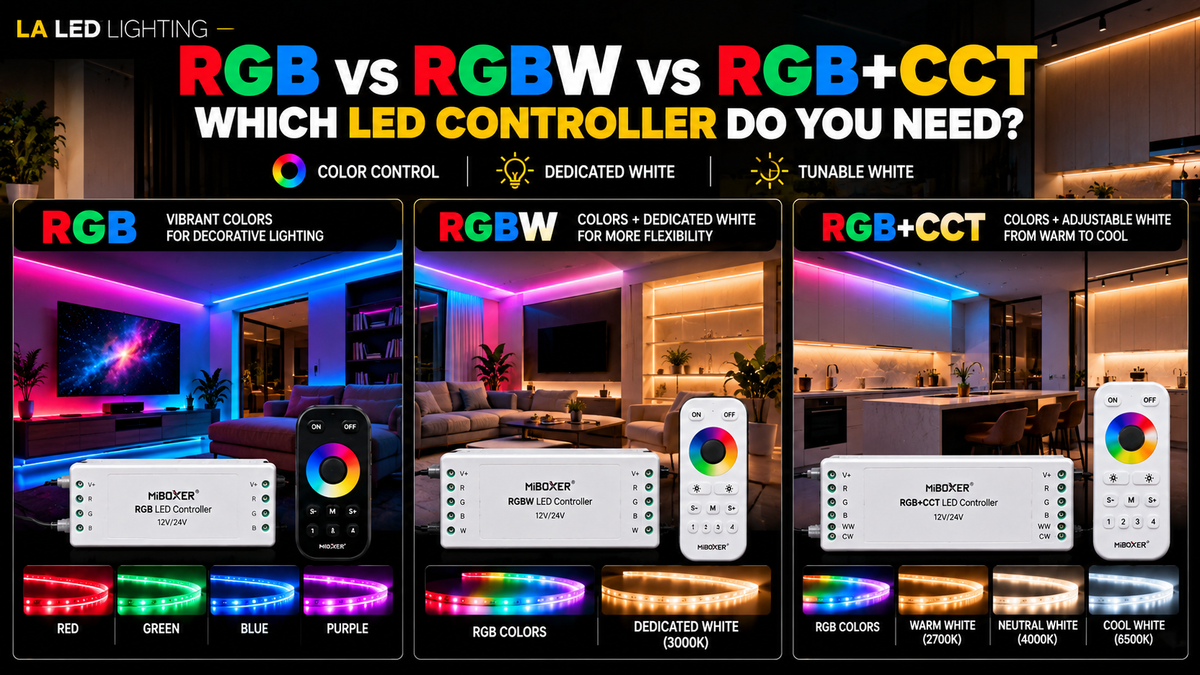
How to Choose Between RGB, RGBW, and RGB+CCT LED Controllers
Choosing the right LED controller is just as important as choosing the right LED strip.
You may already know that RGB LED strips can produce colorful lighting effects. But what happens when you want a true white light? Or when you need to adjust the white color temperature from warm to cool?
That's where RGBW and RGB+CCT systems come in.
Although RGB, RGBW, and RGB+CCT controllers all support color-changing LED lighting, they are not interchangeable in every installation.
Each type is designed for a different combination of LED channels, lighting functions, and control requirements.
Choosing the wrong controller can result in missing colors, unavailable white-light functions, incorrect wiring, or an LED strip that doesn't operate as expected.
In this guide, we'll explain the differences between RGB, RGBW, and RGB+CCT LED controllers, compare their features, and help you choose the right option for your lighting project.
1. What Does an LED Controller Do?
An LED controller manages the electrical output delivered to a compatible LED strip.
In a typical low-voltage installation, the controller is connected between a suitable constant-voltage LED driver and the LED strip.
The controller adjusts the output channels to change lighting characteristics such as:
Color
Brightness
White-light output
Color temperature
Dynamic lighting effects
Depending on the controller model, commands may come from a handheld remote, wall panel, smartphone app, or compatible automation system.
However, the controller must support the electrical configuration of the connected LED strip.
For example, an RGB strip requires three color-control channels, while an RGB+CCT strip typically requires five channels.
Understanding these differences is essential before purchasing a controller.
All four interface types are represented in our controllers and remotes range: handheld remotes, wall panels, and app control through Wi-Fi.
2. What Is an RGB LED Controller?
RGB stands for Red, Green, and Blue.
An RGB LED controller manages three color channels.
By adjusting the intensity of each channel, the system can create a wide range of colors.
For example:
Red + Green = Yellow
Red + Blue = Magenta
Green + Blue = Cyan
Red + Green + Blue = An approximation of white
The final appearance depends on the LED strip and controller.
What Can an RGB Controller Do?
A compatible RGB controller typically supports:
Color selection
Brightness adjustment
Color-changing effects
Dynamic lighting modes
Speed adjustment for supported effects
Can RGB LED Strips Produce White Light?
RGB strips can combine red, green, and blue light to create a white-looking output.
However, this mixed white may not have the same appearance or color-rendering characteristics as a dedicated white LED channel.
For applications where white lighting is used frequently, RGBW or RGB+CCT may be a better choice.
Best Applications for RGB Controllers
RGB systems are popular for:
Gaming rooms
Entertainment centers
Decorative wall lighting
Home theaters
Party lighting
Retail displays
Accent lighting
When Should You Choose RGB?
Choose RGB when colorful decorative lighting is your main priority and you do not need a dedicated white-light channel.
Our RGB pairing is the MiBoxer FUT037S controller with the RGB Dotless COB Strip (10mm, 630 LEDs/m, 5.5 W/ft).
3. What Is an RGBW LED Controller?
RGBW stands for Red, Green, Blue, and White.
An RGBW LED controller manages four lighting channels.
The first three channels control RGB colors.
The fourth controls a dedicated white LED channel.
This provides an important advantage over standard RGB lighting.
Why Does a Dedicated White Channel Matter?
RGB lighting creates white-looking light by combining colored LEDs.
RGBW lighting includes separate white LEDs that can provide more natural-looking white illumination, depending on the strip's specifications.
For example, an RGBW strip may include a dedicated 3000K warm white channel.
The controller can operate that channel independently or combine it with RGB colors when supported.
Main Benefits of RGBW
Full RGB color control
Dedicated white-light output
Brightness adjustment
Decorative color effects
Greater flexibility for mixed-use lighting
Can RGBW Change from Warm White to Cool White?
Not through its dedicated white channel alone.
A typical RGBW strip contains one fixed-color-temperature white channel.
If that channel is 3000K, it remains a 3000K white channel.
Some controllers can mix RGB colors with the white channel to alter the overall appearance, but this is not equivalent to having separate warm and cool white LEDs.
Best Applications for RGBW Controllers
RGBW is useful for:
Living room accent lighting
Kitchen decorative lighting
Bedroom lighting
Display cabinets
Restaurants
Entertainment spaces
Architectural accents
When Should You Choose RGBW?
Choose RGBW when you want colorful lighting plus a dedicated white-light channel, but do not require independent warm-to-cool white adjustment.
Our RGBW pairing is the FUT038S controller with the RGBW COB Strip (12mm, 784 LEDs/m), or the pre-paired RGBW control kit which includes a matching 4-zone remote.
4. What Is an RGB+CCT LED Controller?
RGB+CCT combines RGB color control with adjustable white color temperature.
CCT stands for Correlated Color Temperature.
A typical RGB+CCT LED strip uses five channels:
Red
Green
Blue
Warm White
Cool White
The controller manages the RGB channels for decorative colors and the warm and cool white channels for tunable white lighting.
What Makes RGB+CCT Different?
Unlike RGBW, which normally uses one dedicated white channel, RGB+CCT uses two white channels.
By adjusting the balance between warm and cool white LEDs, the system can produce different white-light appearances.
For example:
Warm White
Comfortable lighting for living rooms, bedrooms, and dining spaces.
Neutral White
Useful for kitchens, offices, and general-purpose lighting.
Cool White
A crisp appearance for task-oriented environments.
The actual available color-temperature range depends on the LED strip.
Main Benefits of RGB+CCT
RGB color-changing capability
Dedicated warm white channel
Dedicated cool white channel
Adjustable white color temperature
Brightness control
Decorative lighting effects
Greater flexibility for everyday illumination
Best Applications for RGB+CCT Controllers
RGB+CCT systems are especially useful for:
Modern kitchens
Living rooms
Bedrooms
Home offices
Restaurants
Hospitality spaces
Luxury architectural lighting
Multi-purpose rooms
When Should You Choose RGB+CCT?
Choose RGB+CCT when you want colorful decorative lighting and the flexibility to adjust white light from warm to cool.
On the control side we carry the FUT039 RGB+CCT controller at 6A per channel, the FUT092 4-zone remote, and the RGB+CCT kit pairing the two. Note that a five-channel RGB+CCT strip is a separate product type from the RGB and RGBW strips above — if your project needs full RGB+CCT, confirm your strip source before specifying the controller around it.
5. RGB vs RGBW vs RGB+CCT: Key Differences
The main difference between these controller types is the number and purpose of their output channels.
| Feature | RGB | RGBW | RGB+CCT |
|---|---|---|---|
| Color channels | 3 | 3 | 3 |
| Dedicated white channels | 0 | 1 | 2 |
| Typical total channels | 3 | 4 | 5 |
| RGB colors | Yes | Yes | Yes |
| Dedicated white light | No | Yes | Yes |
| Adjustable warm-to-cool white | No | No | Yes |
| Brightness control | Yes | Yes | Yes |
| Decorative color effects | Yes | Yes | Yes |
| Best for | Color effects | Colors + fixed white | Colors + tunable white |
| Relative system complexity | Lower | Medium | Higher |
This comparison assumes standard analog constant-voltage LED strips and matching controllers.
Addressable LED strips use different control methods and should not be treated as interchangeable with these conventional RGB systems.
For addressable work we carry the SP638E SPI controller (up to 600 pixels) with the COB IC Addressable RGB Strip.
6. Which Controller Produces the Best White Light?
The answer depends on what you mean by “best.”
RGB
RGB can create a white-looking color by mixing red, green, and blue.
However, it does not have a dedicated white LED channel.
RGBW
RGBW includes a dedicated white channel.
This can provide a better option for regular white illumination, particularly when the LED strip uses high-quality white LEDs.
RGB+CCT
RGB+CCT includes separate warm and cool white channels.
This allows the user to adjust white-light appearance across the supported color-temperature range.
For customers who regularly use white lighting and want maximum flexibility, RGB+CCT is often the most versatile option.
However, color rendering, brightness, and overall light quality still depend on the LED strip itself.
A controller cannot improve the inherent color-rendering specifications of the LEDs.
That last point is worth weighing carefully. If white light is the main requirement and colour is occasional, a dedicated white installation will usually outperform any colour system: our single-colour COB range is CRI ~90 throughout, and the CCT COB Strip tunes 2700K–6500K on two channels with a FUT035 controller.
7. How to Match the Controller to Your LED Strip
One of the most common purchasing mistakes is choosing a controller without checking the LED strip configuration.
The controller must match the strip's channel arrangement and electrical requirements.
Typical Channel Configurations
| LED Strip Type | Typical Control Channels | Matching Controller |
|---|---|---|
| Single Color | 1 | Single-color controller |
| CCT | 2 | CCT controller |
| RGB | 3 | RGB controller |
| RGBW | 4 | RGBW controller |
| RGB+CCT | 5 | RGB+CCT controller |
Each row of that table has a matching controller in our range: FUT036S for single colour (12A), FUT035 for CCT, FUT037S for RGB, FUT038S for RGBW and FUT039 for RGB+CCT.
Example: Connecting an RGB+CCT Strip
A typical RGB+CCT strip has connections for:
Common positive (+)
Red (R)
Green (G)
Blue (B)
Warm White (WW)
Cool White (CW)
A compatible five-channel controller manages these outputs.
If you use a basic RGB controller, it will not provide independent control of the warm and cool white channels.
Important Note
Some controllers support multiple lighting modes.
For example, certain MiBoxer 5-in-1 models can be configured for different LED strip types.
Always confirm the supported operating modes and wiring arrangement before installation.
8. Can You Use an RGBW Controller with an RGB Strip?
Sometimes, but compatibility must be confirmed.
A multi-mode controller that explicitly supports RGB operation can generally be configured for an RGB strip.
However, a fixed-function RGBW controller should not automatically be assumed compatible with every RGB strip.
The controller's wiring design, channel configuration, and operating modes determine whether the combination is supported.
Can You Use an RGB+CCT Controller with RGBW?
Only if the controller explicitly supports RGBW operation.
A five-channel RGB+CCT controller is not necessarily interchangeable with a four-channel RGBW controller.
Some multi-mode controllers support both configurations, but others do not.
Never rely on the number of terminals alone to determine compatibility.
If you expect to change strip types later, a multi-mode unit avoids the question entirely — see the 5-in-1 section below.
9. Understanding MiBoxer 5-in-1 LED Controllers
One practical option for installations involving different LED strip types is a multi-mode controller.
Certain MiBoxer 5-in-1 controllers support several lighting configurations through selectable operating modes.
Depending on the specific model, these may include:
Single Color
CCT
RGB
RGBW
RGB+CCT
This flexibility can simplify product selection when designing different lighting installations.
Example: MiBoxer WL5
The MiBoxer WL5 is a 5-in-1 WiFi + RF LED controller for compatible constant-voltage LED lighting, with a 12–48V input range and Tuya app support. It is also available as a kit with the FUT092 4-zone remote, which gives you app control and a physical remote together.
For Outdoor Installations
The MiBoxer WL5-WP is the IP67-rated version of the same idea, with a DC 12–36V input, for suitable outdoor installations when installed according to its specifications.
Why Choose a Multi-Mode Controller?
A compatible multi-mode controller can provide:
Flexibility across different LED strip types
Simplified inventory selection
Consistent control-system planning
Convenient integration with supported remotes
Options for future lighting upgrades
However, changing controller modes does not change the physical capabilities of the connected LED strip.
For example, an RGB strip will not produce dedicated tunable white light simply because the controller supports RGB+CCT mode.
It is also worth noting that a single-mode controller is usually more compact and less expensive. If the lighting type is fixed and indoors, the FUT035, FUT037S or FUT038S may serve better than a 5-in-1 unit.
10. Choosing the Correct LED Driver
An LED controller does not replace the LED driver.
Most conventional low-voltage LED strip installations require a suitable constant-voltage power supply.
The driver converts incoming AC power into the DC voltage required by the lighting system.
Common LED strip voltages include:
12V DC
24V DC
The controller must support the selected system voltage.
Example: 24V RGBW Installation
Suppose you have a 24V RGBW LED strip requiring 96W at its maximum rated operating condition.
A typical system would include:
24V LED Driver → Compatible RGBW Controller → 24V RGBW LED Strip
The driver must provide enough capacity for the connected load.
The controller must also support the required current.
Wattage Calculation
Use:
Total Wattage = Watts per Foot × Total Length
For example:
8W/ft × 12ft = 96W
A common planning approach is to allow approximately 20–30% additional driver capacity, subject to the manufacturer's requirements.
A suitable 24V driver rated at 120W or more may provide reasonable headroom for a 96W load.
In our range that is the 150W 5-in-1 driver, the next rung above 120W. Every product page in the drivers and transformers range lists output voltage and rated capacity, and the ladder runs from 30W to 384W.
Important Safety Reminder
Always match the LED strip's rated voltage.
A higher-wattage constant-voltage driver does not automatically force extra power into the LED strip.
However, using an incorrect output voltage can damage the LEDs or create unsafe operating conditions.
Note that our 5-in-1 drivers are 12V/24V selectable, so the output must be set to match the strip before the first power-up.
11. Check the Controller's Current Rating
Controller capacity is another essential factor.
Every LED controller has a maximum output-current rating.
Some specify a maximum current per channel and a separate total-current limit.
Both ratings must be respected.
Example
Suppose a five-channel controller supports 6A per channel but has a lower total-current limit than the sum of all five channels.
You cannot assume all channels may operate at 6A simultaneously.
The total output must remain within the manufacturer's specified maximum.
That 6A figure is the real per-channel rating of our FUT039; the single-colour FUT036S is rated at 12A total.
Why Does This Matter?
Overloading a controller can cause:
Excessive heating
Unstable operation
Automatic shutdown
Component damage
Electrical safety hazards
For larger lighting installations, use properly rated equipment and an appropriate power-distribution design.
Where a single zone outgrows its controller, a PA5H 5-channel amplifier extends the load while following the same control signals — its five channels match RGB+CCT exactly, and it also covers RGB, RGBW, CCT and single colour.
12. RF vs WiFi LED Controllers
Once you've selected RGB, RGBW, or RGB+CCT, you also need to decide how you want to control the lighting.
Two common options are RF and WiFi.
RF Controllers
RF stands for Radio Frequency.
These systems communicate with compatible wireless remotes or wall panels.
Advantages may include:
Convenient handheld operation
No direct line of sight required
Simple local control
Multi-zone operation with compatible equipment
WiFi Controllers
WiFi-enabled controllers may support smartphone apps and other connected features.
Depending on the model, these may include:
App-based control
Scheduling
Remote access
Smart-home integration
Voice-assistant compatibility
Which Is Better?
RF is often convenient for straightforward local control.
WiFi may be more attractive when app-based operation and connected features are important.
Some controllers support both RF and WiFi, providing additional flexibility.
Our RF units are the FUT-series controllers and their matching remotes; the WL5 is the unit that does both, accepting Tuya app commands and 2.4GHz RF from the same remotes.
13. Choosing Between a Wall Panel and Handheld Remote
The control interface also affects the user experience.
Wall Panel
A wall-mounted control panel provides a consistent control location.
It can be useful in:
Kitchens
Living rooms
Offices
Commercial interiors
We carry two panels, both 4-zone and both battery-powered: the B3 RGBW panel and the B1-B single-colour panel in black.
Handheld Remote
A handheld remote offers flexible control from different locations.
It can be convenient for:
Home theaters
Bedrooms
Entertainment spaces
Multi-zone lighting systems
Our handhelds are the FUT096 for RGBW, the FUT092 for RGB+CCT and the FUT007 for CCT, all 4-zone.
Example: MiBoxer C8-B
The MiBoxer C8-B is a black eight-zone RGB+CCT handheld remote designed for compatible MiBoxer 2.4GHz lighting systems.
It provides color selection, brightness adjustment, white color-temperature control, and multi-zone operation with suitable receivers.
It is the only 8-zone unit we carry — worth choosing over a 4-zone remote when the installation has more than four separately controlled areas.
Before choosing a remote, verify that it is compatible with the selected LED receiver.
14. Which Controller Is Best for Different Rooms?
Different rooms have different lighting requirements.
| Application | Suggested Controller Type | Main Reason |
|---|---|---|
| Gaming Room | RGB or RGBW | Decorative color effects |
| Home Theater | RGB or RGBW | Color-changing ambient lighting |
| Kitchen | RGB+CCT | Adjustable white for daily tasks |
| Living Room | RGBW or RGB+CCT | Decorative colors plus white light |
| Bedroom | RGB+CCT | Warm-to-cool white flexibility |
| Restaurant | RGBW or RGB+CCT | Atmosphere and functional lighting |
| Retail Display | RGBW or RGB+CCT | Color accents plus white illumination |
| Entertainment Area | RGB | Color-focused effects |
| Home Office | RGB+CCT | Adjustable white lighting |
| Architectural Cove | RGBW or RGB+CCT | Versatile indirect lighting |
These are general recommendations.
The ideal choice depends on the intended lighting effect, budget, installation requirements, and LED strip specifications.
Worth adding to that table: for the kitchen, bedroom, home office and architectural cove rows, a dedicated white installation is often the better answer than a colour system. The 10mm Indoor Dotless COB at 340–415 lm/ft and CRI ~90 will outperform the white output of most colour strips, and a 5-in-1 dimmable driver handles brightness without a controller at all.
15. RGB vs RGBW vs RGB+CCT: Which Is Most Cost-Effective?
RGB systems are often simpler because they use fewer control channels.
RGBW adds a dedicated white channel.
RGB+CCT adds separate warm and cool white channels.
As the number of channels increases, the complete system may become more complex and potentially more expensive.
However, the controller price is only one part of the total installation cost.
You should also consider:
LED strip cost
Power supply requirements
Receiver capacity
Wiring
Installation labor
Lighting performance
Future flexibility
Choose RGB for Simplicity
If you mainly want colorful accent lighting, RGB may provide everything you need — FUT037S plus RGB COB strip.
Choose RGBW for Better White-Light Flexibility
If you want decorative colors and a dedicated white channel, RGBW is a strong option — the RGBW kit bundles the controller and remote.
Choose RGB+CCT for Maximum Versatility
If you want decorative colors and adjustable warm-to-cool white lighting, RGB+CCT provides the most flexibility of these three standard configurations — see the RGB+CCT kit.
16. Common Mistakes to Avoid
Mistake 1: Buying the Controller Before Checking the LED Strip
Always identify the strip's channel configuration first — the table in section 7 maps each one to its matching controller.
Mistake 2: Assuming RGB Creates the Same White as Dedicated White LEDs
Mixed RGB white and dedicated white channels can look different.
Mistake 3: Expecting RGBW to Provide True Tunable White
A typical RGBW strip has one fixed white channel. For genuine tunable white, use a CCT strip.
Mistake 4: Assuming Every Five-Channel Controller Supports Every Mode
Check the manufacturer's supported operating modes.
Mistake 5: Ignoring Voltage Compatibility
The LED strip, controller, and power supply must support the same system voltage. Every strip in our COB range is 24V.
Mistake 6: Exceeding Controller Current Limits
Check both per-channel and total-current ratings.
Mistake 7: Using an Incompatible Remote
Wireless remotes and receivers must support compatible communication protocols. Our controllers and remotes are a single MiBoxer family for this reason, and the matched kits remove the question entirely.
Mistake 8: Confusing Conventional RGB with Addressable RGB
Addressable LED strips use different control methods and require appropriate controllers such as the SP638E.
Mistake 9: Forgetting About the LED Driver
A controller normally does not provide its own AC-to-DC power conversion — see our drivers and transformers.
Mistake 10: Choosing Based Only on Price
The lowest-cost controller may not support the lighting functions you actually need.
Frequently Asked Questions
1. What is the difference between RGB and RGBW LED controllers?
RGB controllers manage red, green, and blue channels. RGBW controllers add a fourth channel for dedicated white LEDs.
2. What is the difference between RGBW and RGB+CCT?
RGBW typically uses one dedicated white channel, while RGB+CCT uses separate warm and cool white channels for adjustable color temperature.
3. Which is better: RGB, RGBW, or RGB+CCT?
RGB is suitable for decorative colors, RGBW adds dedicated white light, and RGB+CCT provides both RGB colors and tunable white lighting.
4. Can an RGB controller operate an RGBW strip?
A basic RGB controller cannot independently control the additional white channel. Compatibility depends on the controller's supported configurations.
5. Can an RGB+CCT controller operate an RGB strip?
Some multi-mode controllers support RGB operation. Check the manufacturer's specifications — the WL5 includes RGB as one of its five modes.
6. Can RGBW produce warm white and cool white?
A standard RGBW strip has one dedicated white channel at a fixed color temperature. It does not provide independent warm and cool white channels.
7. Does RGB+CCT provide better white-light control?
Yes. RGB+CCT supports adjustable white color temperature when paired with compatible LED strips.
8. Do I need a different LED driver for RGB+CCT?
You need a driver with the correct output voltage and sufficient capacity. The driver does not necessarily need to be labeled RGB+CCT.
9. Can one controller operate multiple LED strips?
Yes, provided the controller supports the connected electrical load and the installation is designed correctly.
10. What is a 5-in-1 LED controller?
A 5-in-1 controller supports several selectable lighting modes, commonly including single-color, CCT, RGB, RGBW, and RGB+CCT — see the MiBoxer WL5.
11. Can I use an RGB+CCT remote with any RGB+CCT controller?
Not necessarily. The remote and receiving controller must support compatible communication protocols. Our matched kits pair a remote and controller designed to work together.
12. What does CCT stand for?
CCT stands for Correlated Color Temperature, which describes the appearance of white light in kelvins.
13. Is RGB+CCT suitable for kitchen lighting?
Yes. It can provide decorative RGB colors and adjustable white lighting for different kitchen activities.
14. Can RGB+CCT LED strips be dimmed?
Yes, when used with compatible dimmable controllers and properly designed power supplies.
15. Are RGB+CCT controllers compatible with addressable RGB strips?
Not automatically. Addressable RGB strips require controllers that support their specific digital control protocol, such as the SP638E with the COB IC addressable strip.