
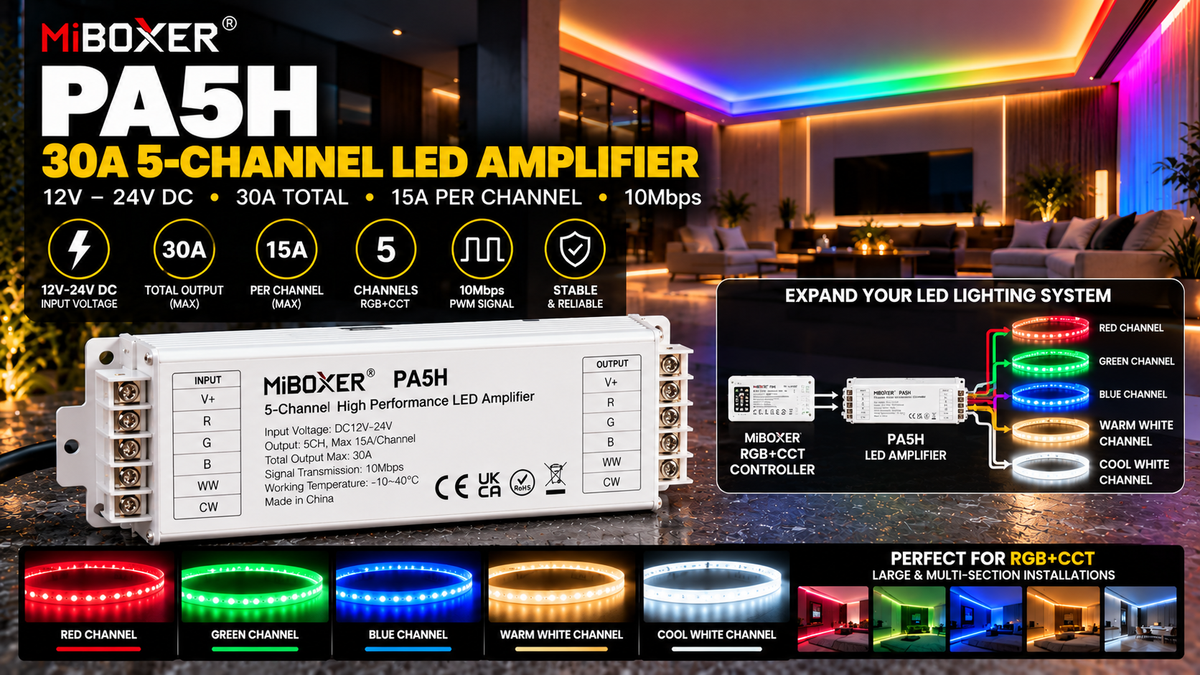
MiBoxer PA5H 30A 5-Channel High Performance LED Amplifier: Expand Your LED Lighting Without Losing Control
Installing LED strip lights is relatively straightforward when you're working with a small cabinet, shelf, or decorative feature.
But what happens when your lighting project becomes much larger?
Imagine installing RGB+CCT LED strips around a large living room ceiling, illuminating several retail displays, or creating synchronized architectural lighting across multiple sections of a commercial space.
A standard LED controller may not have enough output capacity to handle the entire installation.
You could divide the lighting into separate systems, but coordinating their brightness and colors might become inconvenient.
This is where the MiBoxer PA5H 30A 5-Channel High Performance LED Amplifier becomes useful.
Designed to expand compatible PWM LED lighting systems, the PA5H reproduces the main controller's output signals while supplying additional power to connected LED strips.
The result is a more flexible lighting system in which multiple LED strip sections can follow the same dimming, color, and color-temperature commands.
Product: MiBoxer PA5H 5-Channel High Performance LED Amplifier
Operating Voltage: DC 12–24V
Maximum Total Output: 30A
Maximum Per-Channel Output: 15A
Signal Transmission Rate: 10Mbps
Protection Rating: IP20
View the MiBoxer PA5H at LA LED Lighting
1. What Is an LED Amplifier?
An LED amplifier is a device that reproduces the control signals from a compatible LED controller and provides additional output capacity for more LED lighting.
It is especially useful when the total lighting load exceeds the main controller's electrical limits.
For example, suppose you have an RGB+CCT controller that can operate one section of LED strips, but your project requires several additional sections.
Connecting all the strips directly to the controller could exceed its current rating.
Instead, you can use a compatible LED amplifier to control an additional section powered through the amplifier.
The amplifier follows the signals from the original controller, helping maintain coordinated operation.
What Does the MiBoxer PA5H Actually Do?
The PA5H performs two main functions.
1. Reproduces PWM Control Signals
It follows the compatible PWM signals generated by the main LED controller.
2. Provides Additional Output Capacity
It supplies current to additional LED strips through its own DC power input, subject to its electrical ratings.
This allows larger lighting installations to be divided into manageable powered sections.
What the PA5H Does Not Do
The PA5H is not a standalone smart controller.
It does not independently select colors, create lighting schedules, or communicate directly with a smartphone.
It also does not convert household AC electricity into low-voltage DC power.
A compatible LED controller and suitable DC power supply are required.
Both are needed alongside it: a unit from our LED controllers and remotes range to generate the signals, and a constant-voltage supply from our drivers and transformers range to power the strips.
2. Why Would You Need an LED Amplifier?
The main reason to use an amplifier is to expand a lighting installation beyond the output capacity of a single controller.
Every LED controller has a maximum current rating.
For example, a controller might support a total output of 12A or 20A.
If your lighting installation requires more current than the controller can safely deliver, you cannot simply connect additional strips and ignore the limit.
An amplifier provides a way to add another powered lighting section while maintaining synchronized control.
Those figures are real ones from our own range: the FUT036S single-colour controller is rated at 12A, and the WL5 5-in-1 at 20A. Once a run exceeds those ceilings, an amplifier is the way to extend it without a second control system.
Example: Large RGB+CCT Ceiling Installation
Imagine a modern living room with RGB+CCT COB LED strips installed around the ceiling perimeter.
The installation includes several long lighting sections.
Instead of powering the entire system through one controller, you could design it with:
A main compatible RGB+CCT controller
A first LED strip section connected to the controller
A MiBoxer PA5H amplifier
A separate appropriately sized DC supply for the amplifier
Additional RGB+CCT LED strip sections connected to the amplifier
When the main controller changes color or brightness, the amplifier follows the corresponding PWM signals.
This provides a coordinated lighting effect without routing all the additional strip current through the original controller.
For the main controller in that example, our RGB+CCT option is the FUT039 at 6A per channel, or the WL5 if app control is wanted.
3. Five Channels for Flexible LED Lighting Applications
One of the PA5H's biggest advantages is its five-channel design.
Five PWM output channels make it particularly suitable for RGB+CCT LED lighting.
RGB+CCT systems typically use five controlled channels:
| Channel | Lighting Function |
|---|---|
| Channel 1 | Red |
| Channel 2 | Green |
| Channel 3 | Blue |
| Channel 4 | Warm White |
| Channel 5 | Cool White |
With the appropriate controller and wiring configuration, the PA5H can reproduce all five signals.
This helps additional RGB+CCT strip sections display coordinated colors and white-light settings.
Is the PA5H Only for RGB+CCT?
No.
It can also be used with other compatible common-anode PWM systems, including:
Single Color
Reproduce brightness control for additional single-color LED strips — such as our 10mm Indoor Dotless COB, using one of the five channels.
CCT
Control additional warm-white and cool-white LED channels, as on the CCT COB Strip — two channels.
RGB
Extend red, green, and blue lighting sections, as on the RGB COB Strip — three channels.
RGBW
Extend RGB lighting with a dedicated white channel, as on the RGBW COB Strip — four channels.
RGB+CCT
Reproduce all five channels for advanced color and tunable-white lighting.
The amplifier does not automatically detect or independently generate these lighting modes. It follows the compatible signals supplied by the main controller.
Note that a five-channel RGB+CCT strip is a separate product type from the four above. Our current strip range covers single colour, CCT, RGB and RGBW — so if your project is built on five-channel RGB+CCT strip, confirm the strip source before specifying the amplifier around it.
4. 30A Maximum Output for Larger LED Installations
The MiBoxer PA5H supports up to 30A total output current.
Each individual channel supports up to 15A.
These are two separate electrical limits, and both must be respected.
Important: Five channels rated at 15A each do not mean the amplifier can supply 75A in total.
The maximum combined output remains 30A.
PA5H Output Capacity
| Specification | Rating |
|---|---|
| Number of channels | 5 |
| Maximum per channel | 15A |
| Maximum combined output | 30A |
| Operating voltage | DC 12–24V |
How Much LED Power Can the PA5H Support?
The theoretical total output power can be calculated using:
Power (W) = Voltage (V) × Current (A)
At 12V:
12V × 30A = 360W
At 24V:
24V × 30A = 720W
| Operating Voltage | Total Current Limit | Theoretical Maximum Power |
|---|---|---|
| 12V DC | 30A | 360W |
| 24V DC | 30A | 720W |
These are theoretical electrical limits, not recommended continuous design loads.
Actual usable capacity depends on per-channel loading, the LED strip configuration, the power supply, wiring, thermal conditions, and manufacturer requirements.
Worth knowing in practice: 720W is more than any single driver we stock. Our largest is the 384W 4-Channel, followed by the 300W 5-in-1 and the 288W Triple-Output. An installation approaching the amplifier's ceiling would need more than one power supply, so the driver capacity — not the amplifier — is usually what limits the design.
Why the Per-Channel Limit Matters
Suppose an installation uses only one output channel.
Even though the amplifier has a 30A total rating, that single channel must remain within its 15A limit.
Likewise, if several channels are used simultaneously, their combined current must remain within 30A.
A properly designed system must satisfy both conditions.
For a single-colour run on one channel, 15A at 24V is about 360W — roughly 84ft of our 10mm COB strip at 4.27 W/ft, or about 49ft of the 12mm Double-Row at 7.32 W/ft.
5. Compatible with 12V and 24V LED Strip Systems
The PA5H supports DC 12V and DC 24V operation.
These are common voltages for constant-voltage LED strips.
12V Applications
12V LED strips are often used for smaller installations, decorative displays, and short accent-lighting sections.
In our range the 12V option is the 8mm SMD LED Strip at 1.7 W/ft.
24V Applications
24V strips are commonly selected for larger architectural lighting projects.
For the same power, a 24V system draws approximately half the current of a 12V system.
This can help reduce wiring losses and voltage-drop concerns when the installation is properly designed.
Every strip in our COB range is 24V for this reason — which also means the amplifier's 30A ceiling buys twice the wattage it would at 12V.
Important Voltage Rule
The amplifier must receive the correct voltage for the connected LED strips.
For example:
24V LED Strip → 24V DC Power Supply → PA5H Amplifier
Do not use a 24V output to power a strip designed for 12V.
Also, do not assume that the amplifier converts between 12V and 24V.
It is not a voltage converter.
6. How Does the PA5H Keep LED Strips Synchronized?
The PA5H receives PWM signals from the main controller and reproduces them at its outputs.
PWM stands for Pulse Width Modulation.
In many LED lighting systems, PWM controls brightness by switching LED channels on and off rapidly and adjusting the proportion of time each channel remains energized.
For multi-channel lighting, different PWM signals determine the output of each color channel.
For example, an RGB+CCT controller may adjust red, green, blue, warm white, and cool white channels independently.
The amplifier follows those signals so that additional connected LED sections respond to the same commands.
Example: Changing from Warm White to Blue
Imagine an RGB+CCT installation in a restaurant.
The main controller is configured to produce warm white lighting during dinner.
Later, the lighting changes to blue for an evening event.
With a compatible PA5H amplifier connected correctly, the additional strip sections can follow the same channel changes.
This makes the amplifier valuable for coordinated lighting installations.
Does Synchronization Guarantee Identical Colors?
Not necessarily.
The amplifier can reproduce compatible control signals, but actual light appearance also depends on:
LED strip model and LED binning
Color temperature
Supply voltage
Voltage drop
Strip age
Thermal conditions
Installation materials
For the best visual consistency, use matching LED strip products and a carefully designed power distribution system.
The practical version of that advice is to buy every section of the installation as the same strip product, ideally in one order, rather than mixing models or topping up later from a different batch.
7. High-Speed 10Mbps Signal Transmission
The PA5H uses a high-speed optical coupler and high-current MOSFET output design.
The manufacturer specifies a 10Mbps signal transmission rate.
This technology helps the amplifier reproduce compatible PWM signals from the main controller.
The optical coupling also helps separate the control signal interface from the amplifier's output circuitry.
However, the 10Mbps specification should not be confused with WiFi speed or internet connectivity.
The PA5H is not a WiFi device.
It is a wired PWM LED signal amplifier.
If wireless or app control is what you need, that comes from the controller instead — see the WL5 for Wi-Fi and Tuya, or the 2.4GHz RF controllers and remotes.
8. Can You Use Multiple PA5H Amplifiers?
Yes, multiple compatible amplifiers can be used in a larger system when the installation is designed according to the manufacturer's instructions.
This can be useful when lighting is divided into several sections.
For example:
Main Controller → Amplifier 1 → Additional LED Section
Main Controller or Compatible Signal Distribution → Amplifier 2 → Another LED Section
Each amplifier supplies its own connected LED load through an appropriately sized DC power source.
The main controller provides the common lighting commands.
Applications for Multiple Amplifiers
Large ceiling cove installations
Retail store lighting
Hotel architectural lighting
Commercial displays
Restaurants
Entertainment venues
Multi-section RGB+CCT lighting
Although multiple amplifiers can extend a system, the installation is not literally unlimited.
Practical limits still include power supply capacity, wiring, signal integrity, electrical protection, voltage drop, and thermal conditions.
Each amplifier needs its own supply, so a two-amplifier system means two or more drivers — compare capacity across the drivers and transformers range when planning the layout.
9. Best Applications for the MiBoxer PA5H
Large Ceiling Cove Lighting
A large room may require multiple LED strip sections to illuminate its ceiling perimeter.
The PA5H can help expand the controlled load while preserving coordinated dimming and color adjustments.
For the cove itself, the 8mm and 10mm Indoor Dotless COB strips are the usual choices.
Commercial Retail Displays
Retail stores often use LED strips to illuminate shelves, displays, and architectural details.
An amplifier allows additional lighting sections to follow compatible control signals.
For shelf reveals, the 6.5mm Ultra Slim fits where a wider strip will not.
Restaurants and Hospitality
Restaurants may use RGB+CCT lighting to create different atmospheres throughout the day.
The PA5H can support larger synchronized lighting layouts.
Entertainment Rooms
Home theaters and entertainment spaces frequently use RGB or RGBW accent lighting.
The amplifier can provide additional capacity for larger installations.
For these, the RGB and RGBW COB strips are the matching products, paired with a FUT037S or FUT038S controller.
Architectural COB LED Lighting
Compatible constant-voltage COB LED strips can create smooth, continuous-looking lines of light.
The PA5H can be used with appropriate single-color, CCT, RGB, RGBW, or RGB+CCT COB systems, depending on the controller and wiring configuration.
10. MiBoxer PA5H Technical Specifications
| Specification | Details |
|---|---|
| Brand | MiBoxer |
| Model | PA5H |
| LA LED Part Number | LA-AMP-PA5H-5CH-30A |
| Product Type | 5-Channel LED Signal Amplifier |
| Input Voltage | DC 12–24V |
| Number of Channels | 5 |
| Maximum Current per Channel | 15A |
| Maximum Total Output | 30A |
| Signal Transmission Rate | 10Mbps |
| Connection Type | Common Anode |
| Output Technology | High-Current MOSFET |
| Signal Technology | High-Speed Optical Coupler |
| Protection Rating | IP20 |
| Operating Temperature | −10°C to +40°C |
| Approximate Dimensions | 134 × 70 × 23.5mm |
| Compatible Systems | Suitable common-anode PWM LED systems |
11. How to Connect the MiBoxer PA5H
The PA5H is installed as part of a compatible low-voltage LED lighting system.
A typical arrangement includes:
A main PWM LED controller
A compatible LED strip section controlled by that controller
The PA5H amplifier receiving the appropriate PWM control signals
A correctly rated DC power supply feeding the amplifier
Additional LED strips connected to the amplifier outputs
Simplified Connection Concept
Main LED Controller → PWM Signal → PA5H Amplifier → Additional LED Strips
Compatible DC Power Supply → PA5H Power Input
The amplifier follows the controller's PWM signals while supplying additional output current to its connected LED section.
This is a conceptual overview, not a terminal-by-terminal wiring diagram.
For item 4, size the supply against the strip load on the amplifier's outputs — every product page in our drivers and transformers range lists output voltage and rated capacity.
Installation Precautions
Before connecting the amplifier:
Turn off all power supplies.
Verify the required LED strip voltage.
Confirm the controller uses compatible common-anode PWM outputs.
Follow the PA5H manufacturer's wiring diagram.
Check every channel's current requirement.
Keep total output current within 30A.
Use appropriately sized wiring and protection.
Verify polarity and channel assignments.
Provide suitable ventilation.
Keep the IP20-rated amplifier in an appropriate dry, protected location.
When using multiple power supplies, follow the manufacturer's guidance for signal reference and power connections. Do not combine power supply outputs or connect controller and amplifier power circuits in an unsupported configuration.
For complex or permanent installations, use a qualified electrician.
12. PA5H Amplifier vs. LED Controller vs. LED Driver
These three components have different purposes.
| Component | Main Function |
|---|---|
| LED Driver / Power Supply | Supplies the required DC voltage and power |
| LED Controller | Generates dimming or color-control commands |
| PA5H LED Amplifier | Reproduces compatible PWM signals and supplies additional output capacity |
For example, a 24V RGB+CCT installation may use a 24V driver, an RGB+CCT controller, and one or more PA5H amplifiers.
Each component performs a separate function.
The amplifier cannot replace the controller or the power supply.
All three live in separate places on our site: drivers and transformers, controllers and remotes, and the PA5H amplifier itself.
13. Common Mistakes to Avoid
Mistake 1: Assuming 15A per Channel Means 75A Total
The maximum combined output is 30A, not 75A.
Mistake 2: Using the Wrong Voltage
The amplifier does not convert 12V to 24V or 24V to 12V.
Mistake 3: Treating the PA5H as a Standalone Controller
It requires compatible PWM control signals from a controller.
Mistake 4: Connecting an Incompatible Controller
Verify common-anode PWM compatibility and correct signal assignments.
Mistake 5: Ignoring Power Supply Capacity
The amplifier requires sufficient DC power for its connected load — size a driver against the strip wattage on its outputs, not against the amplifier's 30A rating.
Mistake 6: Installing the Amplifier Outdoors Without Protection
The PA5H is IP20-rated and is not designed for direct exposure to rain or water. For outdoor work it must sit inside a protected enclosure or in a dry interior space, with only the low-voltage output running outside to an outdoor-rated strip.
Mistake 7: Ignoring Voltage Drop
Adding an amplifier does not eliminate the need for proper wire sizing and power distribution.
Mistake 8: Assuming the Amplifier Fixes Every Color Mismatch
The amplifier reproduces signals; it cannot correct differences caused by mismatched strips, voltage drop, or aging.
14. When Should You Choose the PA5H?
The PA5H is worth considering when:
Your LED installation exceeds the output capacity of a single controller.
You need to add powered LED sections without losing synchronized control.
Your system uses compatible 12V or 24V PWM lighting.
You are expanding an RGB+CCT installation.
You need additional output capacity for architectural or commercial LED lighting.
You want to preserve coordinated dimming or color commands across multiple sections.
For a small LED strip installation already within the controller's rated capacity, an amplifier may not be necessary.
The best approach is to calculate the lighting load and determine whether the existing controller can safely handle it.
Check the rated current on the controller's product page first. If the load fits inside it, the amplifier is an unnecessary cost.
Frequently Asked Questions
What is the MiBoxer PA5H used for?
The PA5H is a five-channel PWM LED amplifier used to expand the output capacity of compatible LED lighting systems while following the main controller's signals.
Does the PA5H support 24V LED strips?
Yes. It supports compatible 12V and 24V DC LED lighting systems. Every strip in our COB range is 24V.
What is the maximum current of the PA5H?
The maximum combined output is 30A, with a maximum of 15A on any individual channel.
Can the PA5H handle 75A total?
No. Its five channels do not provide 75A combined capacity. The total maximum is 30A.
Can I use the PA5H with RGB+CCT LED strips?
Yes. It is particularly suitable for compatible five-channel RGB+CCT PWM systems.
Can I use it with RGBW LED strips?
Yes, provided the controller, wiring, and strip configuration are compatible — see the RGBW COB Strip and FUT038S controller.
Does the PA5H work with single-color COB LED strips?
Yes. It can reproduce compatible single-color PWM signals and power additional single-colour COB strip sections.
Is the PA5H a WiFi controller?
No. It is a wired PWM LED signal amplifier, not a standalone WiFi controller. For Wi-Fi control see the MiBoxer WL5.
Does the PA5H need a separate power supply?
It requires an appropriately rated DC power source for its connected LED load — see our drivers and transformers. The exact arrangement must follow the manufacturer's wiring instructions.
Can I connect multiple PA5H amplifiers?
Yes. Multiple compatible amplifiers can be used in properly designed systems to expand the controlled lighting capacity.
Is the PA5H waterproof?
No. It has an IP20 protection rating and should be installed in a suitable dry, protected environment.
Does the amplifier make LED strips brighter?
It does not increase the intrinsic brightness of correctly powered LED strips. It enables additional compatible LED loads to receive the power and control signals they require.
Can the PA5H work with controllers from other brands?
Potentially, yes. The manufacturer specifies compatibility with common PWM LED controllers, but the electrical interface, common-anode configuration, voltage, and channel assignments must be compatible.