
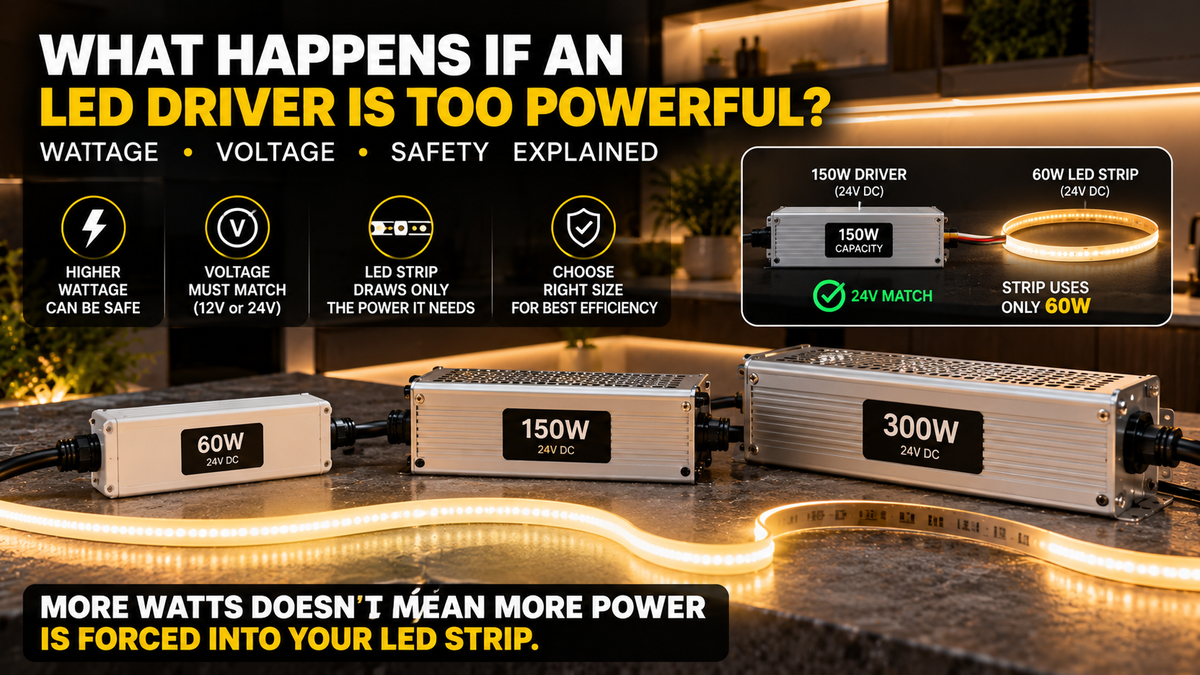
What Happens If an LED Driver Is Too Powerful? Wattage, Voltage & Safety Explained
Choosing the right LED driver is one of the most important steps in building a reliable LED lighting system.
Whether you're installing COB LED strip lights under kitchen cabinets, adding ceiling cove lighting, or planning a larger commercial installation, the LED driver must provide the correct electrical power.
But what happens if your LED driver has more wattage than your lights actually need?
For example:
Can you use a 100W LED driver for a 40W LED strip?
Is a 200W power supply too powerful for 60W of COB LED lighting?
Will a 300W LED driver damage a small LED strip?
Does an oversized LED driver waste electricity?
Is it better to choose a larger driver for future expansion?
The answer depends on the type of LED driver, its output voltage, the connected LED load, and the manufacturer's operating requirements.
For most constant-voltage LED strip installations, using a higher-wattage driver is safe when the voltage matches and the driver is suitable for the connected load.
However, choosing an unnecessarily large driver is not always the best option.
Every product page in our drivers and transformers range lists output voltage, rated capacity, supported load range and dimming method — the four specifications this whole decision turns on.
1. What Does LED Driver Wattage Actually Mean?
An LED driver's wattage rating indicates how much electrical power it is designed to deliver under its specified operating conditions.
For example, a 150W LED driver can supply up to its rated 150W output, subject to its voltage, current, temperature, and other manufacturer limits.
It does not mean the driver continuously sends 150W into every connected LED strip.
The actual power consumed depends primarily on the connected load.
Consider a 24V constant-voltage LED driver rated at 150W.
If you connect a compatible 24V LED strip that consumes 50W, the LED strip will draw approximately 50W under its rated operating conditions.
The remaining 100W represents unused output capacity.
This is similar to a household electrical circuit that can supply more power than an individual appliance needs.
The available capacity does not mean every connected device must consume the maximum amount.
Wattage Capacity vs. Actual Power Consumption
| LED Driver Rating | Connected LED Load | Approximate Output Power Used |
|---|---|---|
| 60W | 40W | 40W |
| 100W | 40W | 40W |
| 150W | 60W | 60W |
| 200W | 60W | 60W |
| 300W | 100W | 100W |
These examples assume compatible, regulated constant-voltage power supplies and LED loads.
Actual power can vary with LED strip characteristics, operating temperature, and dimming settings.
The important point is that driver wattage is a maximum output capacity, not a fixed amount of power forced into the LED strip.
Those five ratings are the rungs of our own 5-in-1 ladder: 60W, 100W, 150W, 200W and 300W, with a 30W and an 80W below them.
2. Can a Higher-Wattage LED Driver Damage LED Strip Lights?
In a correctly designed constant-voltage system, a higher-wattage driver does not automatically damage the LED strip.
For example, imagine you have:
A 24V COB LED strip
Total LED strip power: 60W
A regulated 24V, 150W constant-voltage LED driver
The LED strip requires approximately 60W at its rated voltage.
The driver can supply up to 150W, but the connected strip normally draws only the current it needs.
Because the output voltage is correct, the higher wattage rating alone does not cause overloading.
When Is a Larger Driver Safe?
A higher-capacity driver can be appropriate when:
The output voltage matches the LED strip.
The driver is the correct type for the load.
The LED strip and wiring are correctly connected.
The driver supports the connected load within its operating specifications.
The installation follows the manufacturer's safety requirements.
A 150W driver may therefore operate a 60W strip perfectly well.
However, a 150W driver is not automatically the best choice for every 60W installation.
Efficiency, size, cost, dimming performance, and protection requirements should also be considered.
3. The Most Important Rule: Match the Voltage
While extra wattage capacity is often acceptable, incorrect voltage can be dangerous for LED strip lights.
Most common low-voltage COB LED strips operate at either 12V or 24V DC.
The driver's regulated output voltage must match the strip's required voltage.
Example A: Correct Voltage, Higher Wattage
24V LED Strip, 60W + 24V LED Driver, 150W
This combination can be safe and functional when all other specifications are compatible.
Example B: Incorrect Voltage
12V LED Strip + 24V LED Driver
This combination can severely overdrive the LED strip.
Possible consequences include:
Excessive current
Overheating
LED damage
Component failure
Electrical safety hazards
Example C: Insufficient Voltage
24V LED Strip + 12V LED Driver
The strip may fail to illuminate properly, appear unusually dim, or operate unpredictably.
Voltage Compatibility Table
| LED Strip Voltage | Driver Output Voltage | Result |
|---|---|---|
| 12V | 12V | Correct voltage |
| 24V | 24V | Correct voltage |
| 12V | 24V | Unsafe overvoltage |
| 24V | 12V | Undervoltage; poor or no operation |
| 24V | Regulated 24V, higher wattage | Generally acceptable |
Always check the product label and technical specifications before connecting an LED driver.
Every strip in our COB range is 24V, and our SMD strip is the 12V option. Our 5-in-1 drivers are selectable between 12V and 24V, so the output must be set to match the strip before the first power-up — a 60W 5-in-1 set to 24V and connected to a 12V strip is exactly Example B above.
4. Constant Voltage vs. Constant Current: Why the Difference Matters
Not every LED driver works the same way.
This is one of the most important details when evaluating whether a driver is too powerful.
Constant-Voltage LED Drivers
A constant-voltage driver maintains a specified output voltage, such as 12V or 24V.
The connected LED load determines how much current it draws within the driver's capacity.
These drivers are commonly used for constant-voltage LED strip lights, including many COB and SMD products.
For example:
A regulated 24V, 200W driver can supply a compatible 24V, 60W LED strip without forcing the full 200W into it.
Constant-Current LED Drivers
A constant-current driver regulates output current rather than maintaining one fixed voltage.
These drivers are used for LED modules and fixtures specifically designed for current-controlled operation.
For example, an LED module may require 350mA or 700mA.
Connecting a module to a constant-current driver with an excessive current setting can overdrive the LEDs.
This may cause overheating, reduced lifespan, or immediate damage.
A constant-current driver also has a specified output voltage compliance range, which must be compatible with the connected LED load.
Comparison
| Feature | Constant Voltage | Constant Current |
|---|---|---|
| Regulated output | Voltage | Current |
| Typical application | LED strips | Certain LED fixtures and modules |
| Common ratings | 12V, 24V | 350mA, 700mA, etc. |
| Larger wattage rating | Often acceptable with compatible load | Must also verify current and voltage range |
| Main selection requirement | Correct voltage and capacity | Correct current and compliance range |
Never assume a constant-current driver can replace a constant-voltage driver simply because its wattage rating is similar.
Everything in our drivers and transformers range is constant-voltage, which is what the strips in this article require.
5. Is a 200W LED Driver Too Powerful for a 60W LED Strip?
Let's examine a realistic installation.
Suppose you're installing 24V COB LED strips in a modern kitchen.
The total connected LED load is 60W.
You have two power supply options:
Option A: 24V, 100W Driver
Option B: 24V, 200W Driver
Both drivers have enough rated capacity for the 60W load.
Both can operate the LED strips if their electrical and operating specifications are compatible.
However, the 100W driver may be the more practical choice.
Why?
A smaller appropriately rated driver may offer:
Lower purchase cost
Smaller physical dimensions
Easier installation
Better efficiency at the intended operating load, depending on the model
Less unnecessary unused capacity
The 200W driver may still be useful if you plan to expand the installation later.
But buying a larger driver does not automatically improve LED performance.
Both options are in our range — the 100W 5-in-1 and the 200W 5-in-1 — and for a 60W kitchen run the 100W is the one we would recommend unless expansion is genuinely planned. An 80W is closer still to the 20% headroom guideline.
6. Does an Oversized LED Driver Waste Electricity?
This is a common misunderstanding.
A 300W LED driver does not automatically consume 300W from the electrical outlet.
If the connected LED strip uses approximately 60W, the driver's output power is approximately 60W.
However, the driver also consumes some energy internally.
This is where efficiency becomes important.
Example
Imagine two drivers supplying the same 60W LED load.
Driver A operates at 90% efficiency at that load.
Driver B operates at 80% efficiency at that load.
| Driver A | Driver B | |
|---|---|---|
| LED Output Power | 60W | 60W |
| Efficiency | 90% | 80% |
| Approximate AC Input | 66.7W | 75W |
| Internal Power Loss | 6.7W | 15W |
These are illustrative efficiency values, not specifications for particular LA LED Lighting products.
The example shows that driver efficiency affects electricity consumption and heat generation.
Some power supplies operate less efficiently at very light loads.
Therefore, an excessively oversized driver can sometimes waste more electricity than an appropriately sized alternative.
However, this is not universal.
Always compare manufacturer efficiency specifications at the expected operating load.
For small loads where an oversized unit would be the wrong answer, our compact dimmable transformers start at 60W in a smaller UL Listed Class 2 housing.
7. Can an Oversized LED Driver Overheat?
A higher-wattage driver does not automatically produce more heat simply because its rating is higher.
Heat generation depends on actual load, conversion efficiency, ambient temperature, and cooling conditions.
A lightly loaded 200W driver may generate less heat than a smaller driver operating close to its maximum rating.
However, an oversized driver can still overheat if it is:
Installed in a poorly ventilated enclosure
Exposed to temperatures above its rating
Covered with insulation contrary to instructions
Installed near other heat-generating equipment
Used outside its approved environmental conditions
Driver size alone does not guarantee safe thermal performance.
Installation Tip
Choose a location that provides the ventilation, mounting clearance, environmental protection, and accessibility required by the manufacturer.
For permanent electrical installations, follow applicable electrical codes and use a qualified electrician where required.
Where cabinet space is tight, a compact transformer fits a ventilated location more easily than a full-size unit, and our transformers with integrated junction box terminate the AC connection inside the driver's own enclosure.
8. How Much Extra Wattage Should an LED Driver Have?
For many constant-voltage LED strip installations, a practical approach is to select a driver with approximately 20% spare capacity.
This means operating at around 80% of the driver's rated output under the intended design conditions.
It is a common design guideline, not a universal manufacturer requirement.
Formula
Recommended Driver Capacity = Total LED Load ÷ 0.8
Example 1: 40W LED Strip
40W ÷ 0.8 = 50W
A suitable driver rated at 60W could be a practical choice.
Example 2: 80W LED Strip
80W ÷ 0.8 = 100W
A suitable 100W driver may be appropriate.
Example 3: 120W LED Strip
120W ÷ 0.8 = 150W
A compatible 150W driver may be a good choice.
Example 4: 240W LED Strip
240W ÷ 0.8 = 300W
A compatible 300W driver may be appropriate, provided the circuit layout, output connections, and wiring support the load.
LED Driver Sizing Table
| Total LED Load | Capacity with 20% Headroom | Example Driver Rating |
|---|---|---|
| 30W | 37.5W | 40W or higher |
| 40W | 50W | 60W |
| 60W | 75W | 80W or 96W |
| 80W | 100W | 100W |
| 100W | 125W | 150W |
| 120W | 150W | 150W |
| 160W | 200W | 200W |
| 240W | 300W | 300W |
These are example capacities. The final choice must meet the manufacturer's electrical and installation requirements.
Our range maps onto that table almost row for row: 60W, 80W (or the 96W IP65), 100W, 150W, 200W and 300W, with the 30W for loads below the first row.
9. Is It Better to Use One Large Driver or Multiple Smaller Drivers?
For larger lighting installations, you may have the option of using one high-capacity driver or several smaller drivers.
Both approaches can work.
One Large Driver
Potential advantages:
Fewer power supplies
Centralized equipment
Simpler maintenance in some installations
Convenient power distribution when properly designed
Potential disadvantages:
Longer low-voltage cable runs
Greater voltage-drop considerations
Larger wiring and distribution requirements
A single point of failure
Multiple Smaller Drivers
Potential advantages:
Shorter power runs
Easier separation of lighting areas
Greater flexibility for some installations
Independent maintenance of individual zones
Potential disadvantages:
More equipment
Additional wiring and mounting requirements
Potentially higher installation cost
More locations requiring access
For example, a large ceiling cove installation may benefit from dividing the lighting into shorter, appropriately powered sections rather than using one distant driver.
The best choice depends on the installation layout, power requirements, dimming system, and applicable electrical standards.
There is also a middle option that gets most of the benefit of both: a 192W Dual-Channel or 288W Triple-Output transformer feeds two or three sections independently from a single enclosure and one AC connection.
10. Can a Larger LED Driver Improve LED Strip Brightness?
Not if the existing driver already provides the correct voltage and sufficient current.
A properly operating 24V LED strip connected to a suitable 24V driver will not become brighter simply because you replace a 100W driver with a 300W model.
The LED strip's brightness is determined by its design and actual operating conditions.
However, replacing an undersized or poorly regulated driver with a properly rated one may restore normal brightness.
For example, an overloaded driver may enter current limiting or protective shutdown.
In that situation, selecting a driver with sufficient capacity can solve the problem.
The improvement comes from correcting inadequate power delivery, not from forcing extra wattage into the LEDs.
If more light is genuinely what you need, that comes from the strip rather than the driver — our 12mm Double-Row COB produces 545–635 lm/ft against the 8mm's 250–270 lm/ft.
11. What Happens If the LED Driver Is Too Small?
An undersized LED driver can create several problems.
Depending on its protection design, the driver may:
Shut down
Restart repeatedly
Limit output current
Experience excessive heating
Produce unstable lighting
Operate outside its recommended conditions
For example, connecting 120W of LED strips to a 60W driver exceeds its rated output.
This is not a suitable installation.
A correctly sized driver should be selected based on the total connected load and the manufacturer's requirements.
A 120W load belongs on a 150W driver, not a 60W one.
12. What About Dimmable LED Drivers?
Driver sizing becomes more complex when dimming is involved.
A dimmable LED driver must be compatible with the selected dimming method.
Common systems include:
TRIAC or phase-cut dimming
ELV dimming
MLV dimming
0–10V dimming
Compatible multi-mode dimming drivers
Some dimmable drivers specify a minimum load.
If the connected LED load is much smaller than the driver's rated capacity, the system may experience:
Flickering
Limited dimming range
Unexpected shutoff
Inconsistent low-brightness behavior
This is why selecting a driver solely by maximum wattage is not enough.
Always check the manufacturer's supported load range and dimmer compatibility.
For LED systems using a separate low-voltage controller, confirm that the power supply and controller are designed to operate together.
Our 5-in-1 dimmable drivers accept all five of the methods listed above in one unit. On minimum load, some units state the range explicitly — the 60W Compact Dimmable Transformer, for example, is specified for 0–100% dimming across a 20–100% load range, which is the figure to check before pairing a large driver with a short strip.
13. Does a Larger LED Driver Last Longer?
Not necessarily.
A driver operating within its rated conditions and with adequate thermal management may achieve a long service life.
However, a higher wattage rating alone does not guarantee longer life.
Factors affecting driver lifespan include:
Internal component quality
Operating temperature
Ambient environment
Ventilation
Load conditions
Input power quality
Moisture protection
Manufacturer design and ratings
A properly selected 100W driver can outperform a poorly designed 300W driver in reliability.
Focus on quality, compatibility, installation conditions, and manufacturer specifications rather than wattage alone.
UL listing and Class 2 certification are a reasonable baseline to insist on — our compact transformers and junction-box transformers are both throughout.
14. What If You Plan to Add More LED Strips Later?
Future expansion is one reason to consider a higher-capacity driver.
For example, suppose your current installation uses 80W of LED strips, but you plan to expand to 140W.
A compatible 200W driver could provide sufficient capacity for the planned future load.
However, you must also confirm that:
The driver supports the present load
The planned total load stays within its rating
The wiring supports the expanded current
The LED controller supports the combined load
Voltage drop remains acceptable
Output protection and distribution are appropriate
A larger driver does not automatically increase the capacity of the connected LED controller.
If a controller is rated for 12A, connecting it to a much larger power supply does not raise its 12A limit.
That 12A figure is a real one: our FUT036S single-colour controller is rated at 12A, which is about 288W at 24V — so a 300W driver behind it would exceed what the controller can pass, even though the driver itself is perfectly safe.
15. Common LED Driver Sizing Mistakes
Mistake 1: Choosing Wattage Before Voltage
Always confirm the required output voltage first.
Mistake 2: Assuming More Watts Mean Brighter LEDs
Extra driver capacity does not automatically increase LED brightness.
Mistake 3: Ignoring Constant-Voltage vs. Constant-Current Compatibility
These driver types are not interchangeable.
Mistake 4: Buying an Extremely Oversized Driver Without Checking Efficiency
A large driver may be unnecessary and could operate inefficiently at a very light load.
Mistake 5: Ignoring Minimum Load Requirements
Some dimmable drivers require a minimum connected load for proper operation.
Mistake 6: Ignoring Controller Ratings
A powerful driver cannot compensate for an undersized LED controller. Check the rating on the controller as well as the driver.
Mistake 7: Overlooking Wire Size and Voltage Drop
Long runs and high currents require careful electrical design.
Mistake 8: Assuming a Higher-Wattage Driver Is Automatically Safer
The complete installation must be appropriately rated and protected.
16. How to Choose the Right LED Driver: Step-by-Step
Follow these steps before purchasing an LED driver for your LED strip installation.
Step 1 — Identify the LED Strip Voltage
Confirm whether the strip requires 12V or 24V DC.
Step 2 — Calculate the Total Wattage
Multiply the strip's power consumption per foot by the total installed length.
For example:
20 feet × 5W per foot = 100W
Every product page in our COB strip range lists W/ft, so this is a single multiplication — 20ft of the 10mm strip at 4.27 W/ft comes to about 85W.
Step 3 — Add Appropriate Capacity Headroom
Using a 20% headroom guideline:
100W ÷ 0.8 = 125W
A compatible 150W driver may be a practical choice — the 150W 5-in-1 is the next rung above 125W in our range.
Step 4 — Confirm the Driver Type
Most common constant-voltage COB LED strips require a regulated constant-voltage power supply.
Step 5 — Check Dimming Compatibility
If you plan to use a wall dimmer or LED controller, verify that the components are compatible. A 5-in-1 driver accepts five dimming methods, which removes most of the guesswork.
Step 6 — Check Installation Conditions
Confirm whether the driver will be installed indoors, outdoors, in a cabinet, or in another enclosure. For outdoor or damp locations, choose from the IP65-rated range.
Step 7 — Verify Wiring and Protection
Make sure the complete system meets current, voltage-drop, protection, and electrical installation requirements.
17. Real-World Examples
Example A: Kitchen Under-Cabinet COB Lighting
LED Load: 48W
LED Voltage: 24V
Available Driver: 24V, 100W
Is the driver too powerful?
No. A compatible regulated 100W driver can operate the 48W load.
The driver has unused capacity, but it does not force 100W into the LED strips.
That said, 48W sits closer to the 60W 5-in-1 on the 20% headroom guideline, and it is a smaller unit to fit inside cabinetry.
Example B: Living Room Ceiling Cove
LED Load: 120W
LED Voltage: 24V
Available Driver: 24V, 150W
Is this a good match?
It can be.
The driver has 30W of spare capacity and operates at 80% of its rated output when the strip draws 120W.
This is consistent with the common 20% headroom guideline.
This is the textbook pairing: a 150W 5-in-1 driver running roughly 28ft of our 10mm COB strip.
Example C: Small Display Shelf
LED Load: 12W
LED Voltage: 24V
Available Driver: 24V, 300W
Will it damage the LEDs?
Not solely because of the wattage rating, assuming the driver is compatible and regulates its output correctly.
However, the 300W driver is likely unnecessary.
A smaller suitable driver may be less expensive, easier to install, and potentially more efficient at this load.
For 12W, the 30W 5-in-1 is the smallest in our range and keeps the load inside the driver's intended operating band — which also matters for dimming performance, as section 12 explains.
Example D: Outdoor Architectural Lighting
LED Load: 180W
LED Voltage: 24V
Available Driver: 24V, 300W
Can this work?
Yes, if the driver is appropriate for the environmental conditions and the wiring, controls, and distribution system are correctly designed.
The 300W rating provides capacity above the 180W load.
However, outdoor use requires proper protection for the driver and all electrical connections.
For an outdoor load of this size, an IP65-rated unit is the right starting point — the 288W Triple-Output or the 384W 4-Channel, both of which also split the run into separately fed sections. Pair either with our Outdoor Dotless COB Strip.
Frequently Asked Questions
Can I use a 100W LED driver for a 50W LED strip?
Yes, if the output voltage and driver type match the strip and the driver supports the connected load.
Can I use a 200W driver for a 60W LED strip?
Yes, a compatible regulated constant-voltage 200W driver can supply a 60W load without forcing 200W into it. A 80W or 100W unit would be the more economical match.
Will a 300W LED driver burn out a 24V LED strip?
Not simply because it is rated at 300W. The correct output voltage, driver type, wiring, and protection are essential.
Does a higher-wattage driver make LED strips brighter?
No. Once a compatible driver provides the required voltage and sufficient capacity, additional wattage rating does not automatically increase brightness.
Does an oversized LED driver consume more electricity?
Not necessarily. Actual input power depends on the LED load and driver efficiency. An oversized driver may be less efficient at light loads, depending on its design.
Is a 150W driver suitable for 100W of LED strips?
It often can be, assuming voltage, driver type, load requirements, and installation conditions are compatible. See the 150W 5-in-1.
What happens if I use a 24V driver with a 12V LED strip?
The excessive voltage can cause overcurrent, overheating, and LED damage. Never use this combination.
Should I always choose the largest LED driver available?
No. Choose a driver with appropriate capacity, compatibility, efficiency, and installation characteristics.
Can I use a larger driver to add more LED strips later?
Yes, provided the driver supports the current load and the future wiring, controls, and total connected load remain within their ratings.
Is 20% extra wattage enough?
Approximately 20% headroom is a common design guideline, but the correct margin depends on manufacturer specifications, environmental conditions, and the application.
Is an oversized dimmable LED driver safe?
It may be electrically safe, but dimming performance can suffer if the connected load falls below the driver's supported minimum. Check the stated load range on the driver's product page.
Can an LED driver be too powerful for a controller?
Yes, in the sense that the power supply may be capable of delivering more current than the controller can safely handle. The controller's own rating must never be exceeded, and appropriate circuit protection is important. See the ratings in our controllers range.
Final Thoughts: Is a More Powerful LED Driver Better?
A higher-wattage LED driver is not automatically dangerous.
For constant-voltage LED strip lighting, the connected load normally draws the power it requires when supplied at the correct regulated voltage.
A 150W driver can operate a 60W LED strip, and a 300W driver can operate a 100W strip, provided all electrical and installation requirements are satisfied.
However, a larger driver is not always the better choice.
Excessive unused capacity may increase cost, size, or efficiency losses, and some dimmable systems require a minimum load.
The best LED driver is not necessarily the one with the highest wattage.
It is the one that provides the correct voltage, sufficient capacity, compatible dimming, reliable protection, and suitable performance for your installation.
Find the Right LED Driver at LA LED Lighting
Planning a new COB LED strip installation or upgrading an existing lighting system?
At LA LED Lighting, you can explore LED drivers and transformers for different residential and commercial lighting requirements.
Whether you need a compact driver for under-cabinet lighting or a higher-capacity model for a larger architectural project, selecting the correct power supply is essential for safe and reliable operation.
Explore the range:
All LED drivers and transformers — 30W to 384W
5-in-1 dimmable drivers — TRIAC, ELV, MLV, 0–10V and PWM in one unit
Compact dimmable transformers — smaller housing for cabinetry
IP65 transformers with junction box — for outdoor and damp locations
COB LED strips — W/ft and lm/ft listed on every product page
Choose your LED strip voltage, calculate the total wattage, and compare compatible driver options before purchasing.